Advertisements
Advertisements
Question
Sohan designed an experiment for the regeneration of sugarcane, where he used cuttings to grow sugarcane. He used two types of cuttings, type ‘A’ and type ‘B’ (Fig.). After a few weeks, type ‘B’ cuttings sprouted and developed into sugarcane plants, whereas the type ‘A’ cuttings did not sprout.
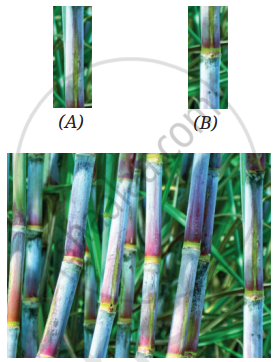
- Why were the type ‘B’ cuttings able to grow as sugarcane but type ‘A’ could not?
- What difference was present in type ‘B’ compared to type ‘A’?
- What observation or measurement was made to determine whether this change had an effect?
- What parameters should be kept the same for both types of cuttings to ensure a fair comparison?
Long Answer
Advertisements
Solution
- Because type “B” cuttings had nodes with buds (meristematic tissue) that could grow into new plants, they grew. Since type “A” lacked nodes, no new growth took place.
- Type “A” had neither nodes nor buds, whereas type “B” had both.
- Whether the cuttings sprouted and grew into new plants was the observation. While type “A” did not exhibit growth, type “B” did.
- Unchanging parameters (fair test):
- The same kind of soil.
- The same amount of water.
- The same sunshine.
- The same temperature and environment.
- Cuttings are the same length and size.
shaalaa.com
Is there an error in this question or solution?
