Advertisements
Advertisements
Question
Sketch the region bounded by the curves y = x2 + 2, y = x, x = 0 and x = 1. Also, find the area of this region.
Advertisements
Solution
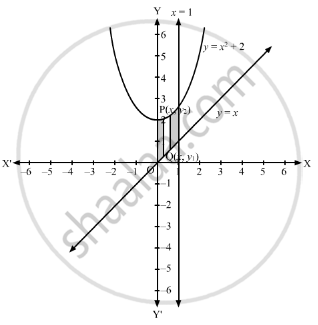
We have,
\[y = x^2 + 2\] and \[y = x\]
We see that parabola and the line \[y = x\] do not intersect \[x = 1\] is a line parallel to y axis Point of intersection between parabola and \[x = 1\] is \[\text{ Putting }x = 1\text{ in }y = x^2 + 2,\text{ we get, }\]
\[y = 1 + 2 = 3\]
\[\text{ Point of intersection of two lines is given by }\]
\[\text{ Putting }x = 1\text{ in }y = x, \text{ we get, }\]
\[y = 1 \]
\[\text{ Consider a vetical strip of length }\left| y_2 - y_1 \right| \text{ and width }= dx \text{ such that }P\left( x, y_2 \right)\text{ lies on parabola and Q }\left( x , y_1 \right)\text{ lies on }y = x\]
\[\text{ Shaded area }= \int_0^1 \left| y_2 - y_1 \right| dx\]
\[ = \int_0^1 \left( y_2 - y_1 \right) dx ..............\left\{ \because \left| y_2 - y_1 \right| \Rightarrow y_2 - y_1 \text{ as }y_2 > y_1 , \right\}\]
\[ = \int_0^1 \left\{ \left( x^2 + 2 \right) - \left( x \right) \right\} dx\]
\[ = \int_0^1 \left( x^2 + 2 - x \right)dx\]
\[ = \left[ \frac{x^3}{3} - \frac{x^2}{2} + 2x \right]_0^1 \]
\[ = \frac{1}{3} - \frac{1}{2} + 2\]
\[ = \frac{2 - 3 + 12}{6}\]
\[ = \frac{11}{6}\text{ sq units }\]
\[\text{ Thus, area enclosed by parabola and given two lines }= \frac{11}{6}\text{ sq units }\]
APPEARS IN
RELATED QUESTIONS
Find the area bounded by the curve y2 = 4ax, x-axis and the lines x = 0 and x = a.
Find the area of the region bounded by the parabola y2 = 16x and the line x = 3.
Find the area of the region bounded by the curve x2 = 16y, lines y = 2, y = 6 and Y-axis lying in the first quadrant.
Using the method of integration find the area of the region bounded by lines: 2x + y = 4, 3x – 2y = 6 and x – 3y + 5 = 0
Find the equation of a curve passing through the point (0, 2), given that the sum of the coordinates of any point on the curve exceeds the slope of the tangent to the curve at that point by 5
Using integration, find the area of the region bounded by the line y − 1 = x, the x − axis and the ordinates x= −2 and x = 3.
Find the area lying above the x-axis and under the parabola y = 4x − x2.
Find the area under the curve y = \[\sqrt{6x + 4}\] above x-axis from x = 0 to x = 2. Draw a sketch of curve also.
Draw the rough sketch of y2 + 1 = x, x ≤ 2. Find the area enclosed by the curve and the line x = 2.
Sketch the region {(x, y) : 9x2 + 4y2 = 36} and find the area of the region enclosed by it, using integration.
Find the area of the region bounded by the parabola y2 = 2x + 1 and the line x − y − 1 = 0.
Find the area of the region bounded by the curves y = x − 1 and (y − 1)2 = 4 (x + 1).
Using integration find the area of the region bounded by the curves \[y = \sqrt{4 - x^2}, x^2 + y^2 - 4x = 0\] and the x-axis.
Find the area enclosed by the curves 3x2 + 5y = 32 and y = | x − 2 |.
If the area enclosed by the parabolas y2 = 16ax and x2 = 16ay, a > 0 is \[\frac{1024}{3}\] square units, find the value of a.
Find the area bounded by the parabola x = 8 + 2y − y2; the y-axis and the lines y = −1 and y = 3.
The area included between the parabolas y2 = 4x and x2 = 4y is (in square units)
The area of the region formed by x2 + y2 − 6x − 4y + 12 ≤ 0, y ≤ x and x ≤ 5/2 is ______ .
Find the coordinates of a point of the parabola y = x2 + 7x + 2 which is closest to the straight line y = 3x − 3.
Sketch the graphs of the curves y2 = x and y2 = 4 – 3x and find the area enclosed between them.
Find the area of the region included between y2 = 9x and y = x
Find the area bounded by the curve y = `sqrt(x)`, x = 2y + 3 in the first quadrant and x-axis.
Draw a rough sketch of the region {(x, y) : y2 ≤ 6ax and x 2 + y2 ≤ 16a2}. Also find the area of the region sketched using method of integration.
Find the area bounded by the curve y = 2cosx and the x-axis from x = 0 to x = 2π
The area of the region bounded by the y-axis, y = cosx and y = sinx, 0 ≤ x ≤ `pi/2` is ______.
Area of the region bounded by the curve y = cosx between x = 0 and x = π is ______.
The area of the region bounded by the ellipse `x^2/25 + y^2/16` = 1 is ______.
If a and c are positive real numbers and the ellipse `x^2/(4c^2) + y^2/c^2` = 1 has four distinct points in common with the circle `x^2 + y^2 = 9a^2`, then
Find the area of the region bounded by `x^2 = 4y, y = 2, y = 4`, and the `y`-axis in the first quadrant.
Find the area of the region bounded by the ellipse `x^2/4 + y^2/9` = 1.
Smaller area bounded by the circle `x^2 + y^2 = 4` and the line `x + y = 2` is.
The area bounded by the curve `y = x^3`, the `x`-axis and ordinates `x` = – 2 and `x` = 1
The area bounded by `y`-axis, `y = cosx` and `y = sinx, 0 ≤ x - (<pi)/2` is
Let T be the tangent to the ellipse E: x2 + 4y2 = 5 at the point P(1, 1). If the area of the region bounded by the tangent T, ellipse E, lines x = 1 and x = `sqrt(5)` is `sqrt(5)`α + β + γ `cos^-1(1/sqrt(5))`, then |α + β + γ| is equal to ______.
Let f(x) be a non-negative continuous function such that the area bounded by the curve y = f(x), x-axis and the ordinates x = `π/4` and x = `β > π/4` is `(βsinβ + π/4 cos β + sqrt(2)β)`. Then `f(π/2)` is ______.
