Advertisements
Advertisements
Question
Find the area bounded by the curves x = y2 and x = 3 − 2y2.
Advertisements
Solution
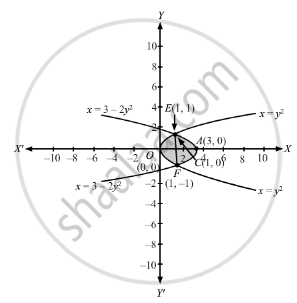
x = y2 is a parabola opening towards positive x-axis , having vertex at O (0,0) and symmetrical about x-axis
x = 3 − 2y2 is a parabola opening negative x-axis, having vertex at A (3, 0) and symmetrical about x-axis, cutting y-axis at B and B'
Solving the two equations for the point of intersection of two parabolas
\[x = y^2 \]
\[x = 3 - 2 y^2 \]
\[ \Rightarrow y^2 = 3 - 2 y^2 \]
\[ \Rightarrow 3 y^2 = 3\]
\[ \Rightarrow y = \pm 1\]
\[y = 1 , \Rightarrow x = 1\text{ and }y = - 1 \Rightarrow x = 1\]
\[ \Rightarrow E\left( 1, 1 \right)\text{ and }F\left( 1, - 1 \right)\text{ are two points of intersection . }\]
\[\text{ The curve character changes at E and F . }\]
\[\text{ Draw EF parallel to y - axis . }\]
\[C(1, 0)\text{ is the point of intersection of EF ith }x -\text{ axis }\]
\[\text{ Since both curves are symmetrical about } x - \text{ axis }, \]
\[\text{ Area of shaded region OEAFO }= 2\text{ Area OEAO }\hspace{0.167em} \]
\[ = 2\left(\text{ Area OECO + area CEAC }\right) . . . . . \left( 1 \right)\]
\[\text{ Area OECO }= \int_o^1 \left| y_1 \right| dx ............\left\{\text{ where }P\left( x, y_1 \right)\text{ is a point on }x = y^2 \right\}\]
\[ = \int_o^1 y_1 dx ............\left\{ \text{ as }y_1 > 0 \right\}\]
\[ = \int_o^1 \sqrt{x} dx\]
\[ = \left[ \frac{x^\frac{3}{2}}{\frac{3}{2}} \right]_0^1 \]
\[ = \frac{2}{3}\text{ sq units .} . . . . \left( 2 \right)\]
\[\text{ area CEAC }= \int_1^3 \left| y_2 \right| dx ...........\left\{\text{ where }Q\left( x, y_2 \right)\text{ is a point on }x = 3 - 2 y^2 \right\}\]
\[ = \int_1^3 y_2 dx ............\left\{\text{ as }y_2 > 0 \right\}\]
\[ = \int_1^3 \sqrt{\frac{3 - x}{2}}dx\]
\[ = \frac{1}{\sqrt{2}} \int_1^3 \sqrt{3 - x} dx\]
\[ = \frac{1}{\sqrt{2}} \left[ - \frac{\left( 3 - x \right)^\frac{3}{2}}{\frac{3}{2}} \right]_1^3 \]
\[ = \frac{1}{\sqrt{2}} \times \frac{2}{3}\left[ 0 + 2^\frac{3}{2} \right]\]
\[ = \frac{2 \times 2\sqrt{2}}{\sqrt{2} \times 3} = \frac{4}{3}\text{ sq . units }. . . . . \left( 3 \right)\]
\[\text{ From }\left( 1 \right), \left( 2 \right)\text{ and }\left( 3 \right), \text{ we get }\]
\[ \text{ Therefore, area of Shaded region OEAFO }= 2\left[ \frac{2}{3} + \frac{4}{3} \right] = 2 \times 2 = 4\text{ sq units }\]
APPEARS IN
RELATED QUESTIONS
triangle bounded by the lines y = 0, y = x and x = 4 is revolved about the X-axis. Find the volume of the solid of revolution.
Find the area bounded by the curve y = sin x between x = 0 and x = 2π.
Area bounded by the curve y = x3, the x-axis and the ordinates x = –2 and x = 1 is ______.
Using integration, find the area of the region bounded between the line x = 2 and the parabola y2 = 8x.
Find the area under the curve y = \[\sqrt{6x + 4}\] above x-axis from x = 0 to x = 2. Draw a sketch of curve also.
Using definite integrals, find the area of the circle x2 + y2 = a2.
Using integration, find the area of the region bounded by the following curves, after making a rough sketch: y = 1 + | x + 1 |, x = −2, x = 3, y = 0.
Find the area of the region bounded by the curve xy − 3x − 2y − 10 = 0, x-axis and the lines x = 3, x = 4.
Compare the areas under the curves y = cos2 x and y = sin2 x between x = 0 and x = π.
Find the area of the region bounded by x2 = 16y, y = 1, y = 4 and the y-axis in the first quadrant.
Find the area bounded by the curve y = 4 − x2 and the lines y = 0, y = 3.
Find the area of the region \[\left\{ \left( x, y \right): \frac{x^2}{a^2} + \frac{y^2}{b^2} \leq 1 \leq \frac{x}{a} + \frac{y}{b} \right\}\]
Using integration, find the area of the triangular region, the equations of whose sides are y = 2x + 1, y = 3x+ 1 and x = 4.
Find the area of the region common to the circle x2 + y2 = 16 and the parabola y2 = 6x.
Find the area of the circle x2 + y2 = 16 which is exterior to the parabola y2 = 6x.
Make a sketch of the region {(x, y) : 0 ≤ y ≤ x2 + 3; 0 ≤ y ≤ 2x + 3; 0 ≤ x ≤ 3} and find its area using integration.
Find the area of the region bounded by the curve y = \[\sqrt{1 - x^2}\], line y = x and the positive x-axis.
Using integration, find the area of the following region: \[\left\{ \left( x, y \right) : \frac{x^2}{9} + \frac{y^2}{4} \leq 1 \leq \frac{x}{3} + \frac{y}{2} \right\}\]
Find the area of the region between the parabola x = 4y − y2 and the line x = 2y − 3.
Find the area bounded by the parabola x = 8 + 2y − y2; the y-axis and the lines y = −1 and y = 3.
The closed area made by the parabola y = 2x2 and y = x2 + 4 is __________ .
The area bounded by the curve y2 = 8x and x2 = 8y is ___________ .
Find the equation of the parabola with latus-rectum joining points (4, 6) and (4, -2).
Find the area of the region bound by the curves y = 6x – x2 and y = x2 – 2x
Find the area of the curve y = sin x between 0 and π.
Find the area of the region bounded by the parabolas y2 = 6x and x2 = 6y.
The area enclosed by the circle x2 + y2 = 2 is equal to ______.
Find the area of the region bounded by the curve y = x3 and y = x + 6 and x = 0
Find the area of the region enclosed by the parabola x2 = y and the line y = x + 2
Find the area of region bounded by the line x = 2 and the parabola y2 = 8x
Find the area of the region bounded by y = `sqrt(x)` and y = x.
Let f(x) be a continuous function such that the area bounded by the curve y = f(x), x-axis and the lines x = 0 and x = a is `a^2/2 + a/2 sin a + pi/2 cos a`, then `f(pi/2)` =
Area of the region bounded by the curve y = |x + 1| + 1, x = –3, x = 3 and y = 0 is
Find the area of the region bounded by `y^2 = 9x, x = 2, x = 4` and the `x`-axis in the first quadrant.
Find the area of the region bounded by the ellipse `x^2/4 + y^2/9` = 1.
What is the area of the region bounded by the curve `y^2 = 4x` and the line `x` = 3.
Using integration, find the area of the region bounded by the curves x2 + y2 = 4, x = `sqrt(3)`y and x-axis lying in the first quadrant.
Let P(x) be a real polynomial of degree 3 which vanishes at x = –3. Let P(x) have local minima at x = 1, local maxima at x = –1 and `int_-1^1 P(x)dx` = 18, then the sum of all the coefficients of the polynomial P(x) is equal to ______.
Sketch the region bounded by the lines 2x + y = 8, y = 2, y = 4 and the Y-axis. Hence, obtain its area using integration.
