Advertisements
Advertisements
Question
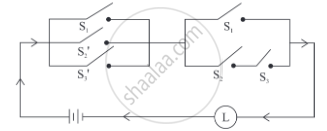
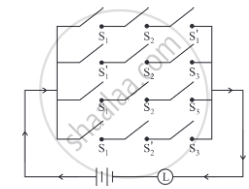
Simplify the given circuit by writing its logical expression. Also, write your conclusion.

Advertisements
Solution
Let p : The switch S1
q : The switch S2
The logical expression for the given circuit is p ∧ (~ p ∨ ~ q) ∧ q
p ∧ (~ p ∨ ~ q) ∧ q
≡ [p ∧ (~ p ∨ ~ q] ∧ q ...[Associative Law]
≡ [(p ∧ ~ p) ∨ (p ∧ ~ q)] ∧ q ...[Distributive Law]
≡ [F ∨ (p ∧ ~ q)] ∧ q ...[Complement Law]
≡ (p ∧ ~ q) ∧ q ...[Identity Law]
≡ p ∧ (~ q ∧ q) ...[Associative Law]
≡ p ∧ F ...[Complement Law]
≡ F ...[Identity Law]
Conclusion: The lamp will not glow irrespective of the status of the switches.
APPEARS IN
RELATED QUESTIONS
Construct the switching circuit for the following statement : [p v (~ p ∧ q)] v [(- q ∧ r) v ~ p]
Find the symbolic form of the following switching circuit, construct its switching table and interpret it.

Simplify the following circuit so that the new circuit has minimum number of switches. Also, draw the simplified circuit.

Find the symbolic form of the given switching circuit. Construct its switching table and interpret your result.

Express the following circuit in the symbolic form of logic and writ the input-output table.
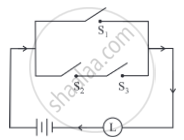
Express the following circuit in the symbolic form of logic and write the input-output table.
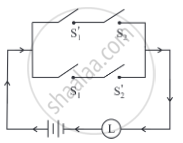
Express the following circuit in the symbolic form of logic and write the input-output table.

Construct the switching circuit of the following:
(∼ p ∧ q) ∨ (p ∧ ∼ r)
Construct the switching circuit of the following:
(p ∧ q) ∨ [∼ p ∧ (∼ q ∨ p ∨ r)]
Construct the switching circuit of the following:
(p ∧ r) ∨ (∼ q ∧ ∼ r)] ∧ (∼ p ∧ ∼ r)
Construct the switching circuit of the following:
(p ∧ ∼ q ∧ r) ∨ [p ∧ (∼ q ∨ ∼ r)]
Give an alternative equivalent simple circuit for the following circuit:
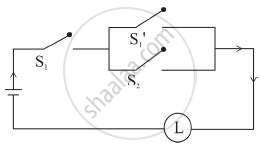
Give an alternative equivalent simple circuit for the following circuit:
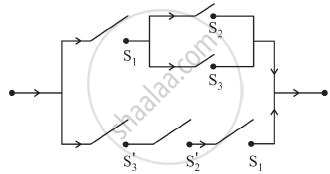
Write the symbolic form of the following switching circuit construct its switching table and interpret it.
Obtain the simple logical expression of the following. Draw the corresponding switching circuit.
p ∨ (q ∧ ∼ q)
Obtain the simple logical expression of the following. Draw the corresponding switching circuit.
(∼ p ∧ q) ∨ (∼ p ∧ ∼ q) ∨ (p ∧ ∼ q)
Obtain the simple logical expression of the following. Draw the corresponding switching circuit.
[p ∨ ( ∼ q) ∨ (∼ r)] ∧ [p ∨ (q ∧ r)]
Obtain the simple logical expression of the following. Draw the corresponding switching circuit.
(p ∧ q ∧ ∼ p) ∨ (∼ p ∧ q ∧ r) ∨ (p ∧ ∼ q ∧ r) ∨ (p ∧ q ∧ r)
Express the following circuit in the symbolic form. Prepare the switching table:
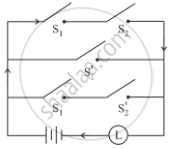
Express the following circuit in the symbolic form. Prepare the switching table:
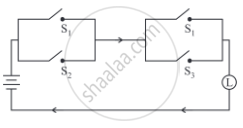
Simplify the following so that the new circuit has a minimum number of switches. Also, draw the simplified circuit.
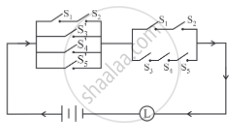
Check whether the following switching circuits are logically equivalent - Justify.
(i)
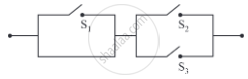
(ii)
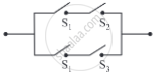
Check whether the following switching circuits are logically equivalent - Justify.
(i)
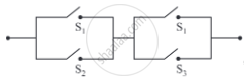
(ii)
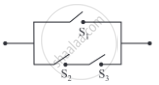
Give alternative arrangement of the switching following circuit, has minimum switches.
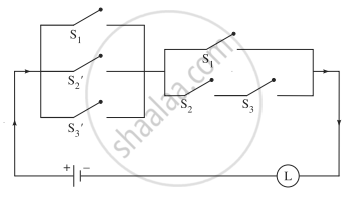
Represent the following switching circuit in symbolic form and construct its switching table. Write your conclusion from the switching table.
A stone is dropped into a pond. Waves in the form of circles are generated and radius of outermost ripple increases at the rate of 5 cm/sec. Then area increased after 2 seconds is ______.

Symbolic form of the given switching circuit is equivalent to:
Find the alternative arrangement using minimum switches for the following switching circuit.

