Advertisements
Advertisements
Question
Show the following animals in outline map of India in the given figure with the help of signs and symbols according to their habitats.
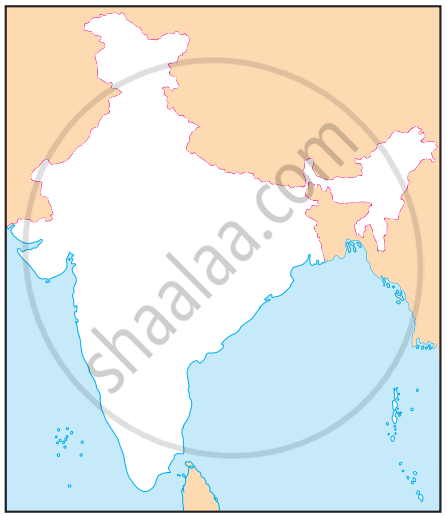
- Bengal Tiger
- Lion
- Great Indian Bustard
- Gangetic Dolphin
- Olive Ridley turtles
- Swamp deers
- One-horned rhinos
- Crocodiles
- Nilgiri Tahr goat
- Gharials
Answer the following questions.
- Correlate geographical conditions and the flora and fauna there.
- Do you know some other animals too?
- Show the habitats of tigers in India with their names on a map.
- Why is their habitat found in these regions?
Advertisements
Solution
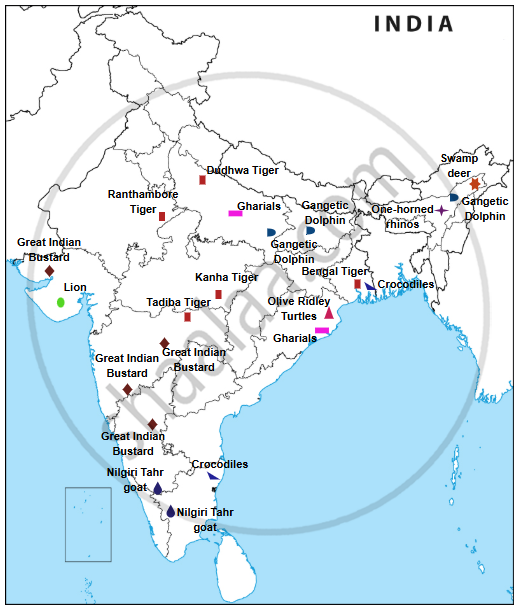
| Q. No. | Symbols | Details |
| 1. |  |
Bengal Tiger |
| 2. |  |
Lion |
| 3. |  |
Great Indian Bustard |
| 4. |  |
Gangetic Dolphin |
| 5. |  |
Olive Ridley Turtles |
| 6. |  |
Swamp deer |
| 7. |  |
One-horned rhinos |
| 8. |  |
Crocodiles |
| 9. |  |
Nilgiri Tahr goat |
| 10. |  |
Gharials |
| 11. | |
Habitats of tigers |
1.
- Geographic conditions have a measurable impact on a region's flora and fauna. Due to India’s very cold environment, the Himalayan range has a limited variety of vegetation and wildlife. The trees in the frigid region have needle-like leaves. The majority of the animals in this region have thick fur.
- The north Indian plains and peninsula physiographic divisions of India have moderate climatic conditions that are ideal for the growth and development of flora and fauna. As a result, these places host a diverse range of flora and fauna.
- That desert has harsh, geographic and climatic characteristics. As a result, this area has a limited range of flora and fauna. This dry region has prickly vegetation. Camels are also present in this area.
- Mangroves and Sundarbans can be found in hot, humid coastal environments like the Sundarbans, which support mangroves as well as a variety of bird and fish species.
2. Some other known animals are Leopard, Cheetah, Fox, Jackal, Elephant, Deer, Camels, etc.
4.
- Grassland is found in Tadoba, Melghat, Pench, Sundarbans, Jim Corbett, Ranthambhor, and other parts of India.
- These grasslands are home to a variety of grazers, including cows, sheep, goats, deer, bison, buffalo, and horses.
- The majority of grazers are food for tigers. Tigers hunt and catch prey.
- Other tiger reserves in India include Tadoba, Melghat, Pench, Sundarbans, Jim Corbett, and Ranthambhor. As a result, the tigers’ natural habitat is limited to certain regions of India.
APPEARS IN
RELATED QUESTIONS
What is the natural habitat for wild ass and camels?
Where are tigers mostly found in India?
What are the steps taken by the government to protect flora and fauna?
What were the objectives of the Wildlife (Protection) Act of 1972?
Name the state animal of Tamil Nadu. Why its population is continuously decreasing?
Where are migrating birds found in India?
Assertion(A):- Peninsular India enjoys an equable climate.
Reason(R):- The peninsular region is surrounded by the seas on three sides, not very far from the sea.
Choose the inappropriate answer.
Biosphere Reserves are protected areas of the coastal and land environment.
Choose the odd man out:
Animals found in the Peninsular region of India.
Match the columns:
| (a) | Evergreen Forests | (i) | Sundar trees |
| (b) | Deciduous Forests | (ii) | Pine |
| (c) | Coastal Forests | (iii) | Pau Brasil |
| (d) | Himalayan Forests | (iv) | Khejadi |
| (e) | Thorny and bush-type vegetation | (v) | Teak |
| (vi) | Orchid | ||
| (vii) | Sal |
