Advertisements
Advertisements
Question
Show that the time period (T) of oscillations of a freely suspended magnetic dipole of magnetic moment (m) in a uniform magnetic field (B) is given by `"T" = 2pi sqrt("I"/"mB")`, where I is a moment of inertia of the magnetic dipole.
Advertisements
Solution
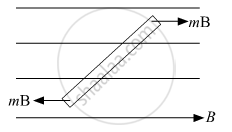
A magnetic dipole of dipole moment m is freely suspended in a uniform magnetic field B. Let the angle between magnetic moment m and magnetic field B is theta, then torque on the dipole is,
r = m × B = mB sinθ ...(1)
Also, torque, r = Iα
` ∵alpha = ("d"^2theta)/("dt"^2)`
`∵ "r" = "I" ("d"^2theta)/("dt"^2)` .....(2)
From eq. (1) and (2), we can write,
`"I" ("d"^2theta)/("dt"^2) = -"mB"sintheta`.....(Because angular acceleration and angle θ are in opposite direction)
For very small deflections, sinθ∼θ
Hence,
⇒ ` "I" ("d"^2theta)/("dt"^2) = -"mB"theta`
⇒ `("d"^2theta)/("dt"^2) = - ("mB"/"I")theta`
By comparing with the standard equation of SHM, we can find that,
`omega^2 = "mB"/"I"`
⇒ `omega = sqrt("mB"/"I")`
⇒ `"T" = (2pi)/omega = 2pisqrt("I"/"mB")`
⇒ `"T" = 2pisqrt("I"/"mB")`
