Advertisements
Advertisements
Question
Show that the given points form a right angled triangle and check whether they satisfy Pythagoras theorem.
L(0, 5), M(9, 12) and N(3, 14)
Advertisements
Solution
The vertices are L(0, 5), M(9, 12) and N(3, 14)
Slope of a line = `(y_2 - y_1)/(x_2 - x_1)`
Slope of LM = `(12 - 5)/(9 - 0) = 7/9`
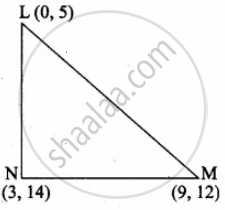
Slope of MN = `(14 - 12)/(3 - 9) = 2/(-6) = -1/3`
Slope of LN = `(14 - 5)/(3 - 0) = 9/3` = 3
Slope of MN × Slope of LN = `-1/3 xx 3` = –1
∴ MN ⊥ LN
∠N = 90°
∴ LMN is a right angle triangle.
Verification:
Distance = `sqrt((x_2 - x_1)^2 + (y_2 - y_1)^2`
LN = `sqrt((3 - 0)^2 + (14 - 5)^2`
= `sqrt(3^2 + 9^2)`
= `sqrt(9 + 81)`
= `sqrt(90)`
MN = `sqrt((9 - 3)^2 + (12 - 14)^2`
= `sqrt(6^2+ (- 2)^2`
= `sqrt(36 + 4)`
= `sqrt(40)`
LM = `sqrt((9 - 0)^2 + (12 - 5)^2`
= `sqrt(9^2 + 7^2)`
= `sqrt(81 + 49)`
= `sqrt(130)`
LM2 = LN2 + MN2
130 = 90 + 40
130 = 130
⇒ Pythagoras theorem is verified.
APPEARS IN
RELATED QUESTIONS
What is the slope of a line whose inclination with positive direction of x-axis is 90°
What is the inclination of a line whose slope is 0
Find the slope of a line joining the points
`(5, sqrt(5))` with the origin
Find the slope of a line joining the points
(sin θ, – cos θ) and (– sin θ, cos θ)
What is the slope of a line perpendicular to the line joining A(5, 1) and P where P is the mid-point of the segment joining (4, 2) and (–6, 4).
Show that the given points are collinear: (– 3, – 4), (7, 2) and (12, 5)
If the three points (3, – 1), (a, 3) and (1, – 3) are collinear, find the value of a
The line through the points (– 2, a) and (9, 3) has slope `-1/2` Find the value of a.
The line through the points (– 2, 6) and (4, 8) is perpendicular to the line through the points (8, 12) and (x, 24). Find the value of x.
Without using distance formula, show that the points (−2, −1), (4, 0), (3, 3) and (−3, 2) are vertices of a parallelogram
