Advertisements
Advertisements
Question
Show that the deflection produced in a moving coil galvanometer is directly proportional to the current flowing through its coil or vice versa.
Advertisements
Solution

A rectangular coil is suspended in a magnetic field `vecB`.
Let PQRS be a rectangular coil carrying current I.
Let PQ = RS = l = be the length of coil and PS = QR = b = breadth of coil.
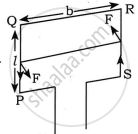
The forces acting on PQ and RS are equal in magnitude but opposite in direction. The magnitude of these forces can be computed as shown below.
`F = I vecl xx vec B`
= I lB sinθ
F = IlB ..(As θ = 90°, sin90° = 1)
When current I is sent through the coil, these forces acting on PQ and RS form a pair that tends to rotate the coil, i.e. torque, which is given by
τ = Force × Perpendicular distance
= IlB × b
∴ τ = IAB, where, A = l × b = Area of coil
For N turns of coil,
Torque (τ) = NIAB
Due to this, torque coil deflects. Therefore, it is called deflecting torque.
∴ Deflection torque = NIAB ...(i)
This pair causes the suspension to twist as the coil rotates. The restoring torque for the coil's deflection (Φ) is given by
Restoring torque = `Kphi` ...(ii)
where K is the torsional constant of the spring.
In equilibrium condition,
Resting torque = Deflecting torque
K`phi` = NIAB
∴ `phi = ((NAB)/K)I`
∴ `phi ∝ I`, where `(NAB)/K` = constant.
i.e., the deflection produced in a moving coil galvanometer is directly proportional to the current in the coil.
