Advertisements
Advertisements
Question
Show that only odd harmonics are present in an air column vibrating in a pipe closed at one end.
Advertisements
Solution
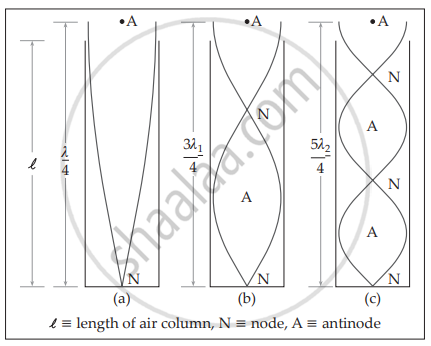
Consider a narrow cylindrical pipe of length l that is closed on one end. When sound waves travel down the air column in a cylindrical pipe that is closed at one end, they are reflected with a phase reversal at the closed end and not at the open end. Under appropriate conditions, interference between incident and reflected waves produces stationary waves in the air column. To account for the end correction e at the open end, the resonating length of the air column is L = l + e.
Let v represent the speed of sound in air. The simplest mode of vibration [Fig. (a)] contains a node at the closed end and an antinode at the open end. The distance between a node and the next antinode is `λ/4`, where λ represents the wavelength of sound. The wavelength (λ) and frequency (n) are:
λ = 4 L
n = `v/λ`
= `v/(4 L)`
= `v/(4(l + e))` ...(1)
This gives the fundamental frequency of vibration, which is known as the fundamental mode or first harmonic.
Figure (b) shows the formation of two nodes and two antinodes in the first overtone, the higher mode of vibration. The equivalent wavelength (λ1) and frequency (n1) are:
`λ_1 = (4 L)/3`
∴ n = `v/λ_1`
= `(3v)/(4L)`
= `(3v)/(4(l + e))`
= 3n ...(2)
As a result, the first overtone’s frequency is three times that of the fundamental frequency, indicating that it is the third harmonic.
The second overtone consists of three nodes and three antinodes (Fig. c). The wavelength (λ2) and frequency (n2) are:
`λ_2 = (4 L)/5`
`n_2 = v/λ_2`
= `(5v)/(4L)`
= `(5v)/(4(l + e))`
= 5n ...(3)
which is the fifth harmonic.
Therefore, in general, the frequency of the pth overtone (p = 1, 2, 3, ...) is:
np = (2p + 1) n ...(4)
i.e. the pth overtone is the (2p + 1)th harmonic.
Equations (1), (2), and (3) show that the ratio of the frequencies produced is:
n : n1 : n2 = 1 : 3 : 5
Since all resultant frequencies are odd multiples of the fundamental frequency, it is mathematically proven that only odd harmonics are present.
RELATED QUESTIONS
What are the forced vibrations and resonance?
Distinguish between forced vibrations and resonance.
Differentiate between free and forced vibrations.
A sonometer wire vibrates with three nodes and two antinodes, the corresponding mode of vibration is ...................
a) First overtone
b) Second overtone
c) Third overtane
d) Fourth overtone
A stretched wire emits a fundamental note of frequency 256 Hz. Keeping the stretching force constant and reducing the length of wire by 10 cm, the frequency becomes 320 Hz. Calculate the original length of wire.
State law of length.
What are forced vibrations?
Show that even as well as odd harmonics are present as an overtone in modes of vibration of the string.
A stretched wire 60 cm long is vibrating with its fundamental frequency of 256 Hz. If the length of the wire is decreased to 15 cm and the tension remains the same. Then the fundamental freuqency of the vibration of the wire will be ______.
