Advertisements
Advertisements
Question
Show that if the diagonals of a quadrilateral are equal and bisect each other at right angles, then it is a square.
Advertisements
Solution
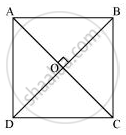
Let us consider a quadrilateral ABCD in which the diagonals AC and BD intersect each other at O. It is given that the diagonals of ABCD are equal and bisect each other at right angles. Therefore, AC = BD, OA = OC, OB = OD, and ∠AOB = ∠BOC = ∠COD = ∠AOD = 90º. To prove ABCD is a square, we have to prove that ABCD is a parallelogram, AB = BC = CD = AD, and one of its interior angles is 90º.
In ΔAOB and ΔCOD,
AO = CO (Diagonals bisect each other)
OB = OD (Diagonals bisect each other)
∠AOB = ∠COD (Vertically opposite angles)
∴ ΔAOB ≅ ΔCOD (SAS congruence rule)
∴ AB = CD (By CPCT) ... (1)
And, ∠OAB = ∠OCD (By CPCT)
However, these are alternate interior angles for line AB and CD and alternate interior angles are equal to each other only when the two lines are parallel.
∴ AB || CD ... (2)
From equations (1) and (2), we obtain
ABCD is a parallelogram.
In ΔAOD and ΔCOD,
AO = CO (Diagonals bisect each other)
∠AOD = ∠COD (Given that each is 90º)
OD = OD (Common)
∴ ΔAOD ≅ ΔCOD (SAS congruence rule)
∴ AD = DC ... (3)
However, AD = BC and AB = CD (Opposite sides of parallelogram ABCD)
∴ AB = BC = CD = DA
Therefore, all the sides of quadrilateral ABCD are equal to each other.
In ΔADC and ΔBCD,
AD = BC (Already proved)
AC = BD (Given)
DC = CD (Common)
∴ ΔADC ≅ ΔBCD (SSS Congruence rule)
∴ ∠ADC = ∠BCD (By CPCT)
However, ∠ADC + ∠BCD = 180° (Co-interior angles)
⇒ ∠ADC + ∠ADC = 180°
⇒ 2∠ADC = 180°
⇒ ∠ADC = 90°
One of the interior angles of quadrilateral ABCD is a right angle.
Thus, we have obtained that ABCD is a parallelogram, AB = BC = CD = AD and one of its interior angles is 90º. Therefore, ABCD is a square.
RELATED QUESTIONS
The angles of quadrilateral are in the ratio 3: 5: 9: 13. Find all the angles of the quadrilateral.
The following statement are true and false .
In any quadrilateral, if a pair of opposite sides is equal, it is a parallelogram.
The following statement are true and false .
If all the angles of a quadrilateral are equal, it is a parallelogram .
The following statement are true and false .
If three sides of a quadrilateral are equal, it is a parallelogram .
The following statement are true and false .
If three angles of a quadrilateral are equal, it is a parallelogram .
If measures opposite angles of a parallelogram are (60 − x)° and (3x − 4)°, then find the measures of angles of the parallelogram.
PQRS is a quadrilateral, PR and QS intersect each other at O. In which of the following case, PQRS is a parallelogram?
OP = 6.5 cm, OQ = 6.5 cm, OR = 5.2 cm, OS = 5.2 cm
The figure formed by joining the mid-points of the adjacent sides of a rectangle is a
In a parallelogram ABCD, if ∠DAB = 75° and ∠DBC = 60°, then ∠BDC =
The diagonals of a parallelogram ABCD intersect at O. If ∠BOC = 90° and ∠BDC = 50°, then ∠OAB =
