Advertisements
Advertisements
Question
Show that the four points P, Q, R, S with position vectors \[\vec{p}\], \[\vec{q}\], \[\vec{r}\], \[\vec{s}\] respectively such that 5 \[\vec{p}\] − 2 \[\vec{q}\] + 6 \[\vec{r}\] − 9 \[\vec{s}\] \[\vec{0}\], are coplanar. Also, find the position vector of the point of intersection of the line segments PR and QS.
Advertisements
Solution
Let the point of intersection of the line segments PR and QS is A. Then \[5 \vec{p} - 2 \vec{q} + 6 \vec{r} - 9 \vec{s} = \vec{0} . \]
\[ \Rightarrow 5 \vec{p} + 6 \vec{r} = 2 \vec{q} + 9 \vec{s} \]
the sum of the coefficients on both the sides of the above equation is 11 .
So, we divide the given equation with 11 .
\[ \Rightarrow \frac{5 \vec{p} + 6 \vec{r}}{11} = \frac{2 \vec{q} + 9 \vec{s}}{11}\]
\[\frac{5 \vec{p} + 6 \vec{r}}{5 + 6} = \frac{2 \vec{q} + 9 \vec{s}}{2 + 9}\]
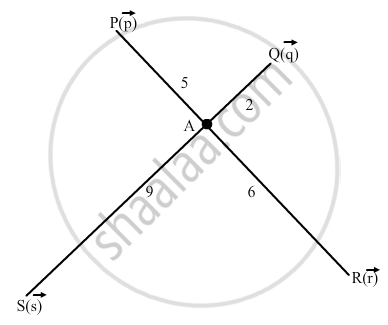
Therefore, A divides PR in the ratio of 5: 6 and QS in the ratio of \[2: 9\]
APPEARS IN
RELATED QUESTIONS
The two vectors `hatj+hatk " and " 3hati-hatj+4hatk` represent the two sides AB and AC, respectively of a ∆ABC. Find the length of the median through A
Find the position vector of a point R which divides the line joining the two points P and Q with position vectors \[\vec{OP} = 2 \vec{a} + \vec{b}\] and \[\vec{OQ} = \vec{a} - 2 \vec{b}\], respectively in the ratio 1 : 2 internally and externally.
Let \[\vec{a,} \vec{b,} \vec{c,} \vec{d}\] be the position vectors of the four distinct points A, B, C, D. If \[\vec{b} - \vec{a} = \vec{c} - \vec{d}\], then show that ABCD is a parallelogram.
Show that the four points A, B, C, D with position vectors \[\vec{a,} \vec{b,} \vec{c,} \vec{d}\] respectively such that \[3 \vec{a} - 2 \vec{b} + 5 \vec{c} - 6 \vec{d} = 0,\] are coplanar. Also, find the position vector of the point of intersection of the line segments AC and BD.
The vertices A, B, C of triangle ABC have respectively position vectors \[\vec{a}\], \[\vec{b}\], \[\vec{c}\] with respect to a given origin O. Show that the point D where the bisector of ∠ A meets BC has position vector \[\vec{d} = \frac{\beta \vec{b} + \gamma \vec{c}}{\beta + \gamma},\text{ where }\beta = \left| \vec{c} - \vec{a} \right| \text{ and, }\gamma = \left| \vec{a} - \vec{b} \right|\]
Hence, deduce that the incentre I has position vector
\[\frac{\alpha \vec{a} + \beta \vec{b} + \gamma \vec{c}}{\alpha + \beta + \gamma},\text{ where }\alpha = \left| \vec{b} - \vec{c} \right|\]
If the position vector of a point (−4, −3) be \[\vec{a,}\] find \[\left| \vec{a} \right|\]
Find the coordinates of the tip of the position vector which is equivalent to \[\vec{A} B\], where the coordinates of A and B are (−1, 3) and (−2, 1) respectively.
If the position vectors of the points A (3, 4), B (5, −6) and C (4, −1) are \[\vec{a,}\] \[\vec{b,}\] \[\vec{c}\] respectively, compute \[\vec{a} + 2 \vec{b} - 3 \vec{c}\].
Show that the points 2 \[\hat{i}, - \hat{i}-4 \] \[\hat{j}\] and \[-\hat{i}+4\hat{j}\] form an isosceles triangle.
If the vertices of a triangle are the points with position vectors \[a_1 \hat{i} + a_2 \hat{j} + a_3 \hat{k} , b_1 \hat{i} + b_2 \hat{j} + b_3 \hat{k} , c_1 \hat{i} + c_2 \hat{j} + c_3 \hat{k} ,\]
what are the vectors determined by its sides? Find the length of these vectors.
Find the position vector of a point R which divides the line segment joining points \[P \left( \hat{i} + 2 \hat{j} + \hat{k} \right) \text{ and Q }\left( - \hat{i} + \hat{j} + \hat{k} \right)\] internally 2:1.
Find the position vector of the mid-point of the vector joining the points P (2, 3, 4) and Q(4, 1, −2).
Show that the points A, B, C with position vectors \[\vec{a} - 2 \vec{b} + 3 \vec{c} , 2 \vec{a} + 3 \vec{b} - 4 \vec{c}\] and \[- 7 \vec{b} + 10 \vec{c}\] are collinear.
Prove that the points having position vectors \[\hat{i} + 2 \hat{j} + 3 \hat{k} , 3 \hat{i} + 4 \hat{j} + 7 \hat{k} , - 3 \hat{i} - 2 \hat{i} - 5 \hat{k}\] are collinear.
If the points with position vectors \[10 \hat{i} + 3 \hat{j} , 12 \hat{i} - 5 \hat{j}\text{ and a }\hat{i} + 11 \hat{j}\] are collinear, find the value of a.
If \[\vec{a,} \vec{b}\] are two non-collinear vectors prove that the points with position vectors \[\vec{a} + \vec{b,} \vec{a} - \vec{b}\text{ and }\vec{a} + \lambda \vec{b}\] are collinear for all real values of λ.
If the points A(m, −1), B(2, 1) and C(4, 5) are collinear, find the value of m.
Show that the points whose position vectors are as given below are collinear: \[3 \hat{i} - 2 \hat{j} + 4 \hat{k}, \hat{i} + \hat{j} + \hat{k}\text{ and }- \hat{i} + 4 \hat{j} - 2 \hat{k}\]
Show that the four points having position vectors
\[6 \hat{i} - 7 \hat{j} , 16 \hat{i} - 19 \hat{j} - 4 \hat{k} , 3 \hat{j} - 6 \hat{k} , 2 \hat{i} - 5 \hat{j} + 10 \hat{k}\] are coplanar.
Show that the four points A, B, C and D with position vectors \[\vec{a}\], \[\vec{b}\], \[\vec{c}\], \[\vec{d}\] respectively are coplanar if and only if \[3 \vec{a} - 2 \vec{b} + \vec{c} - 2 \vec{d} = \vec{0} .\]
Define position vector of a point.
If \[\vec{a}\], \[\vec{b}\], \[\vec{c}\] are position vectors of the points A, B and C respectively, write the value of \[\overrightarrow{AB} + \overrightarrow{BC} + \overrightarrow{AC} .\]
If D is the mid-point of side BC of a triangle ABC such that \[\overrightarrow{AB} + \overrightarrow{AC} = \lambda \overrightarrow{AD} ,\] write the value of λ.
Find the image P' of the point P having position vector `hati+ 3hatj+ 4hatk` in the plane `vecr. (2hati - hatj + hatk) + 3 = 0 .` Hence find the length of PP'.
X and Y are two points with position vectors `3vec("a") + vec("b")` and `vec("a")-3vec("b")`respectively. Write the position vector of a point Z which divides the line segment XY in the ratio 2 : 1 externally.
Find the value of x such that the four-point with position vectors,
`"A"(3hat"i"+2hat"j"+hat"k"),"B" (4hat"i"+"x"hat"j"+5hat"k"),"c" (4hat"i"+2hat"j"-2hat"k")`and`"D"(6hat"i"+5hat"j"-hat"k")`are coplaner.
Find the position vector of a point R which divides the line joining the two points P and Q with position vectors `vec"OP" = 2vec"a" + vec"b"` and `vec"OQ" = vec"a" - 2vec"b"`, respectively, in the ratio 1:2 internally
Find the position vector of a point R which divides the line joining the two points P and Q with position vectors `vec"OP" = 2vec"a" + vec"b"` and `vec"OQ" = vec"a" - 2vec"b"`, respectively, in the ratio 1:2 externally
