Advertisements
Advertisements
Question
A ray of light passing through centre of curvature of a spherical mirror, after reflection
Options
passes through the focus
passes through the pole
becomes parallel to the principal axis
retraces its own path.
Advertisements
Solution
retraces its own path.
APPEARS IN
RELATED QUESTIONS
An object is placed at a distance of 40 cm in front of a convex mirror of radius of curvature 40 cm. List four characteristics of the image formed by the mirror.
In a convex spherical mirror, reflection of light takes place at:
(a) a flat surface
(b) a bent-in surface
(c) a bulging-our surface
(d) an uneven surface
Which type of mirror has:
positive focal length?
The image formed by a spherical mirror is virtual. The mirror will be:
An object is placed at a distance of 6 cm from a convex mirror of focal length 12 cm. Find the position and nature of the image.
An object 1 cm tall is placed 30 cm in front of a convex mirror of focal length 20 cm. Find the size and position of the image formed by the convex mirror.
Write true or false
At the point of incidence, a line drawn at right angles to the surface, separating the two media, is called the normal.
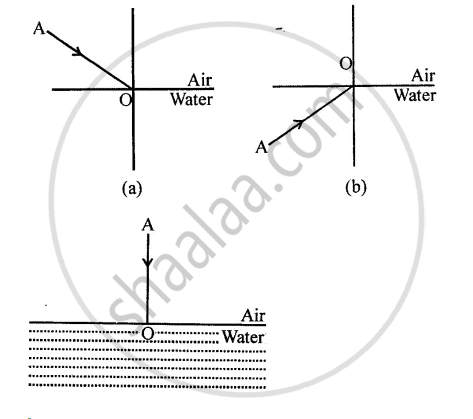
The diagram given below in fig shows a ray of light AO falling on a surface separating two media. Draw the refracted ray in each, case.
A 5 cm tall object is placed perpendicular to the principle axis of a convex lens of focal length 12 cm. The distance of the object from the lens is 8 cm. Using the lens formula, find the position, size and nature of the image formed.
If the object is at infinity in front of a convex mirror the image is formed at infinity.
