Advertisements
Advertisements
Question
Select forest as a natural resource.
- Prepare a map of India showing the distribution of different types of forests.
- Write about the economic importance of forests for the country.
- Prepare a historical account of conservation of forests in India with focus on Chipko movements in Rajasthan and Uttaranchal.
Activity
Advertisements
Solution
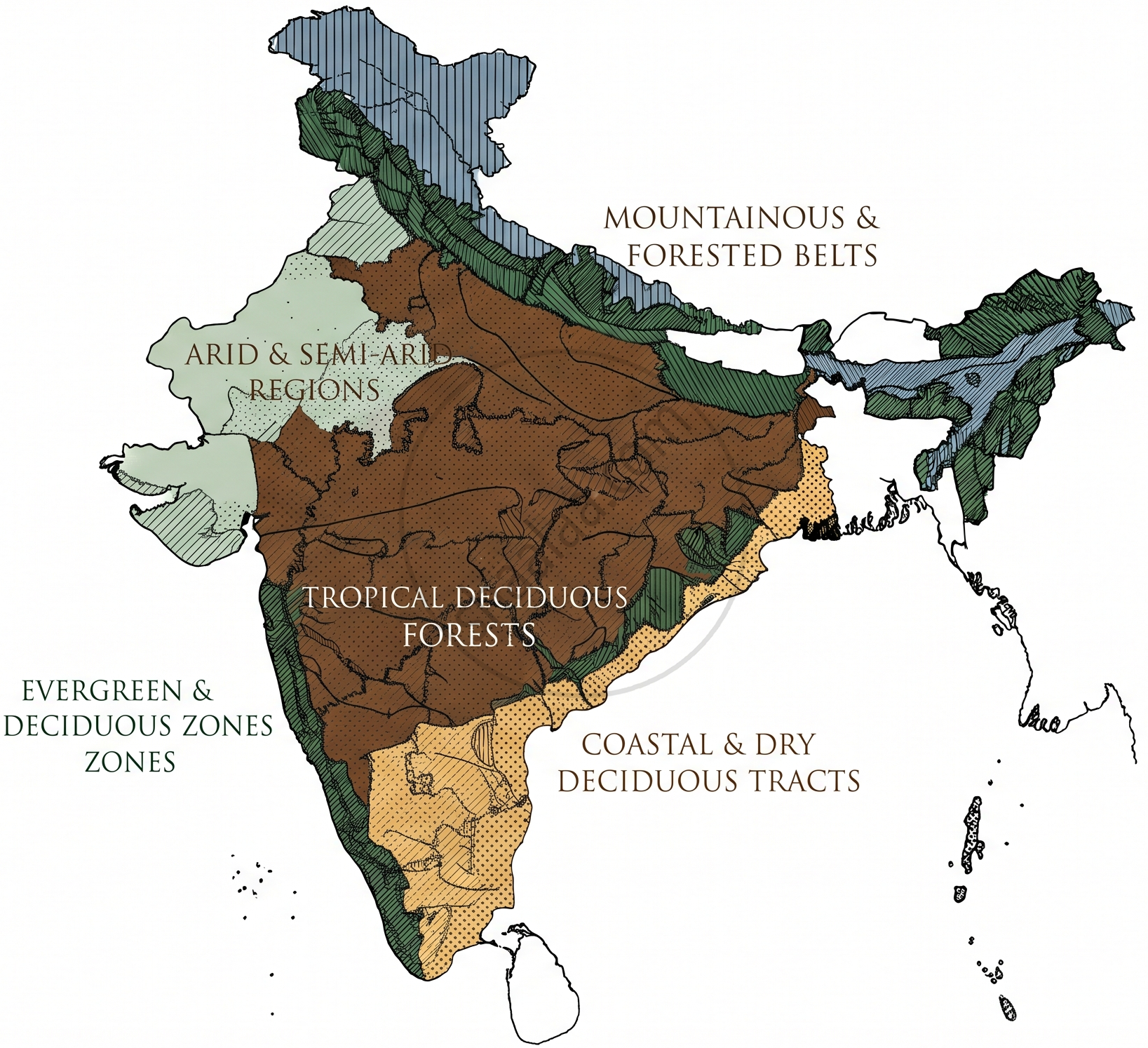
- Economic Importance of Forests for the Country
Forests contribute significantly to India’s economy and sustainable development through multiple avenues:- Timber and Wood Products: Provide commercial timber used in construction, furniture making, packaging, and railway sleepers.
- Raw Materials for Industries: Supply vital raw materials for paper and pulp, matchboxes, sports goods, rayon, and artificial silk industries.
- Non-Timber Forest Products (NTFPs): Yield valuable minor forest produce such as medicinal herbs, gums, resins, lac, honey, rubber, and essential oils that support tribal and rural livelihoods.
- Employment and Revenue: Generate substantial state and national revenue while providing wage employment to millions of forest-dwellers and rural communities engaged in gathering and processing forest goods.
- Eco-Tourism and Livestock Grazing: Serve as hubs for wildlife tourism and provide vital grazing land and fodder for livestock in rural areas.
- Historical Account of Forest Conservation and the Chipko Movements
India has a rich history of community-led forest conservation, highlighted by prominent resistance movements against commercial deforestation:- Early Roots in Rajasthan (The Bishnoi Movement):
- In 1730 AD, villagers in Khejarli, Rajasthan, led by Amrita Devi Bishnoi, sacrificed their lives to protect sacred Khejri trees from being felled by the King of Jodhpur’s axes.
- This historical event is widely recognized as the precursor and spiritual inspiration for modern ecological conservation and tree-hugging protests in India.
- The Modern Chipko Movement in Uttaranchal (Uttarakhand):
- Originating in the early 1970s in the Chamoli district of Uttaranchal (then part of Uttar Pradesh), local villagers—notably led by environmentalists like Sunderlal Bahuguna and Chandi Prasad Bhatt—protested against commercial logging contractors.
- The defining tactic involved villagers literally wrapping their arms around trees (“Chipko” meaning to hug or cling) to physically prevent them from being cut down.
- The movement successfully highlighted the ecological importance of forests in preventing soil erosion, landslides, and flash floods, eventually leading to a government ban on commercial green felling in the Himalayan region.
- Early Roots in Rajasthan (The Bishnoi Movement):
shaalaa.com
Is there an error in this question or solution?
