Advertisements
Advertisements
Question
Renaissance was a period of intellectual activity. In the context, write briefly on the impact of Renaissance on Science under the following heads:
Progress in astronomy
Advertisements
Solution
Copernicus (AD 1473-1543), held that the earth was round and earth, the moon, and other planets moved around the sun in a circle. Later on, German Scientist John Kepler (1571-1630) proved that the earth and the other planets move around the sun not in a circle but in elliptical orbits. Italian Scientist Galileo (1564-1642) invented the telescope. Sir Isaac Newton (1642-1727) discovered the law of Gravitation.
RELATED QUESTIONS
Who was the famous English poet and dramatist in the 16th century?
Mention the names of two celebrated artists of the 16th century?
Name the finest example of Renaissance architecture in Rome.
What was the famous theory introduced by Copernicus?
Who proved the theory of the Law of Gravitation?
Mention two important effects or consequences of the Renaissance.
Who is known as the Father of Humanism?
Renaissance artists tried to depict life on canvas and stone. With reference to this statement, describe the following:
Progress in the art of painting
Renaissance was a period of intellectual activity. In this context, write a short note on William Shakespeare
Study the picture given below and answer the following question:
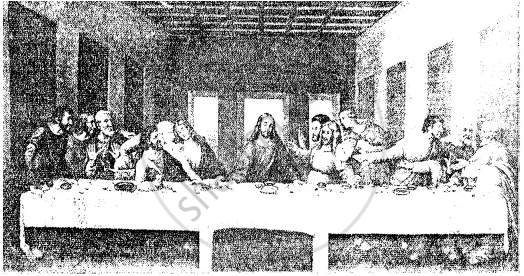
Write short notes on the artist who made this painting.
