Advertisements
Advertisements
Question
Read this text and fill in the blanks with future perfect tense
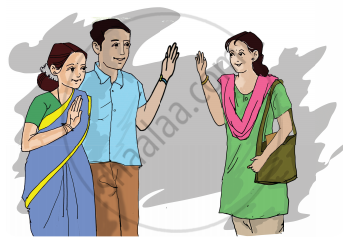
Iniya moves to Chennai to join an IAS coaching class. Tomorrow by this time, she ______ (join) the class. She ______ (undergo) training till next year. She ______(work)very hard by the time she comes home. Her parents______ (worry) about her health all the time. They______ (write)many letters by the time she comes home. They will be very happy when Iniya becomes an IAS officer
Advertisements
Solution
Iniya moves to Chennai to join an IAS coaching class. Tomorrow by this time, she would have joined the class. She will have to undergo training till next year. She would have worked very hard by the time she comes home. Her parents would be worried about her health all the time. They would have written many letters by the time she comes home. They will be very happy when Iniya becomes an IAS officer
APPEARS IN
RELATED QUESTIONS
Add -ly to the following adjectives, then use them to fill in the blank.
1) perfect
2) near
3) kind
4) pleasant
5) eager
_________ write your name and address in capital letters.
Rewrite the following sentence replacing ‘as soon as’ by ‘No sooner than’ (Note: The phrase, ‘No sooner’ must always be followed by an auxiliary (helping verb).)
As soon as the Bill is passed, it will become an Act.
_______ we are impressed with their performance.
The following passage has not been edited. There is one error in the tense of the verb in each line. Write the wrong word as well as the correct word in the given place. One is done for you.
| Sentence | Wrong words | Correct words |
| When Anand reach Arun's place, his | reach | reached |
| friends have arrived already. Arun | ||
| introduces Anand to them. Arun's brother | ||
| buy some snacks from the market. | ||
| Arun serving it to all his friends. Then | ||
| they all sat together to planning their holidays. | ||
| Arun have a cottage in Ooty, so | ||
| they all plan to go to Ooty during the holidays. | ||
| “Would we have a good time?, asked Arun. | ||
| They all cheerfully say, “Yes!” |
Find the describing words given in the poem.
| p | a | s | m | a | I | I | s |
| g | I | a | r | g | e | s | t |
| h | u | e | i | j | k | h | r |
| I | f | t | a | I | I | a | a |
| m | e | n | d | s | p | r | i |
| q | s | r | o | t | a | p | g |
| u | u | v | o | x | y | n | h |
| z | a | d | g | h | e | b | t |
Circle and write the adverbs from the sentence.
Our mum spoke to us angrily. _______
Frame meaningful sentence of your own using the following expression from the story. Use a dictionary if required.
accepted her seclusion with resignation
Underline the gerund in the following sentence.
Jessie enjoys bothering others.
From the (The Story of Tea) passage, copy correctly any three sentences that begin with ‘How’.
Write compound word using the pictures.
 |
+ |  |
| _______________ | ||
