Advertisements
Advertisements
Question
Read the passage given below-
| (1) | Milkha Singh, also known as The Flying Sikh, was an Indian track and field sprinter who was introduced to the sport while serving in the Indian Army. He is the only athlete to win gold in 400 metres at the Asian Games as well as the Commonwealth Games. He also won gold medals in the 1958 and 1962 Asian Games. He represented India in the 1956 Summer Olympics in Melbourne, the 1960 Summer Olympics in Rome and the 1964 Summer Olympics in Tokyo. He was awarded the Padma Shri, India's fourth-highest civilian honour, in recognition of his sporting achievements. |
| (2) | The race for which Singh is best remembered is his fourth-place finish in the 400 metres final at the 1960 Olympic Games. He led the race till the 200 m mark before easing off, allowing others to pass him. Singh's fourth-place time of 45.73 seconds was the Indian national record for almost 40 years. |
| (3) | From beginning that saw him orphaned and displaced during the partition of India, Singh became a sporting icon in the country. In 2008, journalist Rohit Brijnath described Singh as "the finest athlete India has ever produced". |
| (4) | He was disappointed with his debut performance at the 1956 Melbourne Olympics. "I returned to India, chastened by my poor performance in Melbourne. I had been so excited by the prospects of being part of the Indian Olympics team, but, hadn't realized how strong and professional the competition would be. My success in India had filled me with a false sense of pride and it was only when I was on the track that I saw how inconsequential my talents were when pitted against superbly fit and seasoned athletes. It was then that I understood what competition actually meant, and that if I wanted to succeed on the international arena, I must be prepared to test my mettle against the best athletes in the world." |
| (5) | Then he decided to make sprinting the sole focus of his life. "Running had thus become my God, my religion and my beloved". "My life during those two years was governed by strict rules and regulations and a self-imposed penance. Every morning I would rise at the crack of dawn, get into my sports kit and dash off to the track, where I would run two or three miles cross-country in the company of my coach." |
| (6) | On how he pushed himself through the tough days of vigorous training. "I practiced so strenuously that often I was drained of all energy, and there were times when I would increase my speed to such an extent that after my rounds, I would vomit blood or drop down unconscious through sheer exercise. My doctors and coaches warned me, asked me to slow down to maintain my health and equilibrium but my determination was too strong to give up. My only focus was to become the best athlete in the world. But then images of a packed stadium filled with cheering spectators, wildly applauding me as I crossed the finishing line, would flash across my mind and I would start again, encouraged by visions of victory." |
Based on your reading answer any five questions from the six given below: (5)
- What is Milkha Singh known as? What realization did Milkha Singh have when he was on the track during the Melbourne Olympics?
- List any two of Milkha Singh's achievements.
- What strict rules and regulations did Milkha Singh follow?
- State two consequences of his hard and strenuous practice.
- What motivated Milkha Singh to become the best athlete in the world?
- Explain the phrase 'I would start again' in the last sentence.
Advertisements
Solution
- Milkha Singh is known as 'The Flying Sikh'. He realised the true meaning of competitiveness when competing on the track in the Melbourne Olympics. He believed that in order to achieve on a worldwide stage, he needed to be properly prepared to compete against the top athletes in the world.
- Milkha Singh's achievements -
- Milkha Singh is the only Indian to win gold in 400 metres in Asian Games as well as in the Commonwealth Games.
- He was awarded Padma Shri, India's fourth highest civilian honour.
- During those two years, Milkha Singh followed strict rules and regulations. He would get up early in the morning, get into his sports kit and dash to his track where he, along with his coach, would run two or three miles cross-country.
- His hard and strenuous practice drained out his energy leading him to vomit blood and sometimes dropping him unconscious.
- The view of a jam-packed stadium filled with cheering spectators, applauding for him as he crossed the finishing line, motivated him to become world's best athlete.
- Despite the doctor's advice to stop due to his health, Milkha Singh persisted. He was adamant about becoming the world's top athlete. In particular, images of victory and roaring and applause for him rushed through his thoughts. He decided to start afresh as a result of this.
APPEARS IN
RELATED QUESTIONS
Look at the balloons. Which are the qualities inculcated in the author by her teacher? Write them. (2)

Sister Monica, however, wasn't quite as lenient as that, and spent most of the time telling me about the importance of regularity and hard work. She made me realise that success is, like genius, 99 per cent perspiration and 1 per cent inspiration. It's a lesson that has stood me in good stead.
The teachers I'm most grateful to, though, are not those who have taught me the most, but those who have simply been friends to me, believed me and believed in me. Prominent among them is Sudha Ramasubramanium-Rambo, as we used to call her. I didn't know her too well. She taught me in college, and apart from being incredible in class unless one missed class, she also believed that I actualIy had a Problem when I developed an injury (which several doctors found difficult to diagnose). Despite my missing an exam-the HSC, of all exams- she was the only person who told me to concentrate on my health and assured me that I could take the exam off the top of my head any time I wanted to.
I'm not even certain she remembers it, but at the time, it felt like one of the only rays of hope in an extremely dark tunnel. Perhaps few teachers realize how far their influence extends or how much of a difference their actions and words can make. A number of my teachers have unfortunately taught me kindness and tolerance and patience by being precisely the opposite, and quite obviously, they aren't the people I like to think about. But many of my teachers have been extraordinary people, who have not only taught me in class but also helped mould me and my character in every other way. I only hope that I live up to what their endeavors were undoubtedly mean to create.
B2.Answer
(1) What kind of teachers are disliked by the author? (1)
(2) What was Sudha Ramasubramanium's advice to the author when she was going to miss her HSC exam. ? (1)
B3. Match :
Match the words with their appropriate meanings : (2)
| ‘A’ | ‘B’ |
| (i) Prominent | (a) Treatment |
| (ii) Incredible | (b) Natural |
| (iii) Diagnose | (c) Unbelievable |
| (iv) Endeavours | (d) Noticeable |
| (e) Efforts | |
| (f) Identify a disease |
B.4(i) ‘Wh question’
She made me realize that success is, like genius. (1)
(Frame a ‘Wh’ question to get the underlined part as an answer)
(ii) She taught me in college. (1)
(Begin the sentence with ‘I’ and rewrite).
B5. Personal Response
Do you agree that a teacher should also be your good friend? Justify your answer. (2)
1. Why does a person become overconfident? The reason lies in over assessment of his capabilities. Sometimes people over assess their competence and jump into situations that are beyond their control.
2. Napoleon Bonaparte who became Emperor of France would say that the word 'impossible' was common only amongst fools. The overconfident Napoleon invaded Russia in the winter of 1812. This proved to be a big disaster.
3. Overconfidence generally leads people into misadventures, endangering their chances in life. It is wisely said that any achievement is a result of two factorsone's personal planning and support from the external world. People, take into account only their planning, generally ignoring external factors. As a result they are unable to foresee future developments. Hence, a great risk of failure.
4. Then there is the question: how can one manage overconfidence? The formula is very simple. Before taking a decision discuss the matter with other informed people with an objective mind and when it is proved that you are about to go off the path, accept reality and say without delay, "I was wrong'.
5. Overconfidence is a flaw characterizing people who lack the virtue of modesty. Modesty makes you a realist; you become a person who is cut down to size. People of this kind become very cautious; before taking an action they assess the whole situation. They adopt a realistic approach.
6. Overconfident people live within their own thoughts. They know themselves but they are unaware of others. Living inside their own cell they are unable to make use of the experiences of others. This kind of habit is highly damaging to all concerned
7. There is a saying that the young man sees the rule and the old man sees the exception, with a slight change, I would like to say that the overconfident person sees the rule and the confident person sees the exception. Overconfident people are always at risk. It is said that taking risk is good but it must be well calculated otherwise it becomes very dangerous.
1) Answer the following :(8)
a. Why does a person become overconfident?
b. What does overconfidence generally lead people into?
c. How can one manage overconfidence?
d. What kind of person does 'modesty' make you?
2)Find meanings of the words given below with the help of the options that follow :(4)
a. Misadventure (Para 3)
(i) Mishap (ii) Unlucky (iii) Unhappy (iv) Unpleasant
b. Endangering (Para 3)
(i) Reckless (ii) Imperil (iii) Risky (iv) Threatening
c. Assess (Para 5)
(i) Assemble (ii) Acquire (iii) Evaluate (iv) Accept
d. Objective (Para 4)
(i) Obedient (ii) Servile (iii) Honest (iv) Impartial
Read the extract given below and answer the questions that follow :
When I got to New Mullion, my eager expectations of a sweet and simple country village were severely disappointed. Its streets were rivers of mud, with rows of wooden shops, either painted a sour brown, or bare of any paint at all.
(a) Who is 'I'?
(b) Why was 'I' disappointed?
(c) What does the word 'expectations' mean ?
Read the passage given below and answer the questions that follow:
The most alarming of man’s assaults upon the environment is the contamination of air, earth, rivers, and sea with lethal materials. This pollution is for the most part irrevocable; the chain of evil it initiates is for the most part irreversible. In this contamination of the environment, chemicals are the sinister partners of radiation in changing the very nature of the world; radiation released through nuclear explosions into the air, comes to the earth in rain, lodges into the soil, enters the grass or corn, or wheat grown there and reaches the bones of a human being, there to remain until his death. Similarly, chemicals sprayed on crops lie long in soil, entering living organisms, passing from one to another in a chain of poisoning and death. Or they pass by underground streams until they emerge and combine into new forms that kill vegetation, sicken cattle, and harm those who drink from once pure wells.
It took hundreds of millions of years to produce the life that now inhabits the earth and reached a stage of adjustment and balance with its surroundings. The environment contained elements that were hostile as well as supporting. Even within the light of the sun, there were short wave radiations with power to injure. Given time, life has adjusted and a balance reached. For time is the essential ingredient, but in the modern world is no time.
The rapidity of change and the speed with which new situations are created follow the heedless pace of man rather than the deliberate pace of nature. Radiation is no longer the bombardment of cosmic rays; it is now the unnatural creation of man’s tampering with the atom. The chemicals to which life is asked to make adjustments are no longer merely calcium and silica and copper and all the rest of the minerals washed out of the rocks and carried in the rivers to the sea; they are the synthetic creations of man’s inventive mind, brewed in his laboratories, and having no counterparts in nature.
(a) On the basis of your understanding of the above passage make notes on it using headings and sub-headings. Use recognizable abbreviations (wherever necessary-minimum four) and a format you consider suitable. Also supply a title to it.
(b) Write a summary of the passage in about 80 words.
Read the following extract and answer the questions given below:
One day, King Amrit and Chandan were taking a walk on the terrace of the palace. The terrace offered a beautiful view of the surroundings, and they could see far into the distance. They spotted the weekly market from up there, with people in colourful clothes buying and selling all kinds of things. There was plenty to buy and people had money to buy too. There were no poor people to be seen anywhere. The King watched with a smile on his face. He was delighted to see the prosperity of his kingdom. Like any good ruler, he was happy ·when his people were happy.
He turned to Chandan and said, ''See how contented my people are. But I want to check this first-hand by talking to them. Tomorrow, summon people from all walks of life to the court, and I will ask them myself how they are doing.'' Chandan was used to the king's strange requests and went off to carry out this order.
The next day, the King arrived in the court humming a happy tune to himself. Seeing all the people gathered there waiting for him, he was even more pleased. He cleared his throat and said in a loud voice, ''I have called you here to ask you a very important question. As your king, I need to know if all of you are contented. Do you have enough for your needs? Do you know anyone who is not happy about anything?''.
(1) What do you understand about the King from this extract?
(2) Why did the King want to talk to his people?
(3) How did the King come to know about the prosperity of his kingdom?
(4) According to you, what should the Government do for the bettennent of the poor people?
(5) Rewrite the following sentences in the ways instructed :
(i) He was delighted to see the prosperity of his kingdom.
(Make it a rhetorical question.)
(ii) Summon people from all walls of life to the court
(Rewrite it beginning with 'Let ..... ')
(iii) As soon as the King arrived in the court humming a
happy tune to himself, he cleared his throat.
(Rewrite it using 'No sooner .... than'.)
(6) Find out the words from the extract which mean:
(i) development
(ii) examine
Read the following extract and answer the questions given below :
Early risers clearly have the edge in life. By the time most of us wake up, they've been through their morning rituals, enjoyed their walk, had their tea and read the daily news. They're also likely to have made long-distance calls before dawn to those similarly inclined. Thus, by the time the sun warms up they're likely to have discussed all varieties of 'men, matters, and affairs' with a dozen people.
The upshot of these varying tendencies is that such extreme contrasts often exist in the same household. Weeks pass before the younger lot (typically late risers) and the older lot (normally early birds) come face to face. It's almost as if they live in different time zones and different countries.
All over the country, things are likely to be pretty much the same in this respect, one would think. If the man of the house, any house, decides to take a day off from work, he'd probably find his son emerging from his room at about I0 a.m. and that too in a 'rubbing-eyes' mode. After fooling around for a while the lad would probably dash off to college in a rush whilst simultaneously zipping up his jeans and sending text messages on his phone. His father would undoubtedly be left shaking his head and burying himself deeper into his newspaper.
(1) What is the extract about?
(2) How do the early risers get a headstart in life?
(3) What kind of lifestyle of the young son is reflected in the extract?
(4) According to you, why do the youngsters rise up late?
(5) Rewrite the following sentences in the ways instructed:
(i) He goes for his morning walk at 1 p.m.
(Rewrite it in the Present Perfect Continuous Tense.)
(ii) They live in different time zones.
(Make it a complex sentence.)
(iii) The man decides to take a day off from work.
(Rewrite it using the noun form of the underlined word.)
(6) Find out the words from the extract which mean:
(i) have a slight advantage over
(ii) coming out
Read the following extract and answer the questions given below:
Researchers recently announced the earth could actually withstand up to 200,000 times the current population. They arrived at this figure by calculating the amount of heat a human body emits, and only at 1·3 million billion would the earth be too hot to be habitable. And though it would feel like being ina can of sardines if that figure were ever reached, the earth is capable of comfortably sustaining a population several times the current 6·5 billion.
In fact, fertility is actually on the decline worldwide. Though the population has grown, the rate of growth has fallen sharply. Twenty years ago, the UN projected that the population would reach 11·I6 billion in 2050, today they say it will reach only 9·3 billion. Moreover, the human population will stabilize at about 11·5 billion. While this figure is almost twice the current one, it is hardly claustrophobic.
True, the demands on resources are heavy even now, but this is more due to the manner in which these resources are being used. In fact, figures show that a bigger population does not amount to greater consumption. Over 20% of the world's people in the highest-income countries account for 86% of total private consumption expenditure - the poorest 20% a tiny 1·3%. With just 5% of the world's population, the US consumes about 40% of the world's resources. Would you say the US is overpopulated?
Concerns on the scarcity of food are equally baseless. In fact, global food production has actually kept up with population growth. If people starve in many countries it is not because food is becoming scarce; it is because those people cannot afford it.
Questions:
(1) What conclusions did the researchers arrive at?
(2) How does the writer explain that fertility is on the decline?
(3) What does the extract predict about the fear of scarcity of food?
(4) How will the population become a gift in the global market scene?
(5) Rewrite the following sentences in the ways instructed:
(i) The earth could withstand up to 200,000 times the current population.
(Rewrite the sentence using the modal auxiliary showing 'certainty'.)
(ii) The earth would be too hot to be habitable.
(Remove 'too' and rewrite the sentence.)
(iii) These resources are being used.
(Rewrite the sentence beginning with, 'We ........... .')
(6) Write the antonyms of:
(i) habitable
(ii) stabilize
Read the following extract and answer the questions given below.
| A | B |
| (i) valedictorian | (a) feeling of annoyance |
| (ii) frustration | (b) dunce |
| (c) school topper | |
|
(d) validity
|
Read the following extract carefully. (4)
Read the following extract and answer the questions given
below :
In 1945 in Bay Roberts, Canada, a 12-year-old boy saw something in a shop window that set his heart racing. But the price -five dollars-was far beyond Reuben Earle's means. Five dollars would buy almost a week's groceries for his family.
Reuben couldn't ask his father for the money. Everything Mark Earle made by fishing, Reuben's mother, Dora, stretched like elastic to feed and clothe their five children.
Nevertheless, he opened the shop's weathered door and went inside. Standing proud and straight in his flour-sack shirt and washed out trousers, he told the shopkeeper what he wanted, adding, "but I don't have the money now. Can you please hold it for me?" ·
"I will try," the shopkeeper smiled. ''Folks around here don't usually have that kind of money to spend on things. It should keep for a while.,.
Reuben respectfully touched his worn cap and walked out into the May sunlight. The bay rippled in a freshening wind that ruffled his short hair. There was purpose in his loping stride. He
would raise the five dollars and not tell anybody.
Hearing the sound of hammering from a side street, Reuben had an idea.
He ran towards the sound and stopped at a construction site. People built their own homes in Bay Roberts, using nails purchased in burlap sack from a local factory. Sometimes the sacks were discarded in the flurry of buildings, and Reuben knew he could sell them back to the factory for five cents a piece.
(1) What did Reuben decide to do to raise the required amount?
(2) How much money did Reuben need? Why?
(3) Why couldn't Reuben ask his father for the money?
(4) What is special about the gifts which are given on special occasions?
(5) Rewrite the following sentences as directed :
(i) Reuben couldn't ask his father for the money.
(Rewrite the sentence using ' be able to'.)
(ii) Hearing the sound of hammering from a side street, Reuben had an idea.
(Rewrite the sentence using 'and'.)
(iii) He could sell them back to the factory.
·(Rewrite the sentence beginning with: 'They ..... ')
(6) Match the words in column 'A' with their meanings in
column 'B':
| column 'A' | column 'B' |
| folk | natural harbour |
| bay | sticks |
| people |
On this historic moment, I stand here to thank Pandit Jawaharlal Nehru. India’s present epoch maker has come over here to bless the state of Maharashtra which is definitely going to last forever. On behalf of thousands of common people, I express my deep sense of gratitude to him for blessing us. We Maharashtrians love him, worship him. And once again, I wish to declare that this state of Maharashtra, recently formed, will work for the betterment of the common people of Maharashtra, but if it comes to sacrifice, whatever best and grand we have, it will be done primarily for India. This is so, because, we believe from the beginning, that Maharashtra depends on India; its greatness depends on the greatness of India. All Maharashtrians believe that both India and Maharashtra can progress only when there is oneness of interest. And, therefore, I have made this clear by bringing to your notice the significance of certain symbols, for example, the Himalayas stand for lndia and the Sahyadri, for Maharashtra. The snowy Himalayas with the highest mountain ranges symbolise India and the Sahyadri with the blackest rock structure and with 200-300 inches rainfall symbolise Maharashtra. I promise you that if the Himalayas are in jeopardy, the Sahyadri of Maharashtra will use its black rock structure like a shield to protect the Himalayas.
‘Hard labour’ is the watch word of our times. And, Panditji, you have given us the message of building Maharashtra and our nation by hard labour. We are going to inscribe this valuable message on our minds and try our best to look at your blessings and your guidance, as the blessings and guidance of an epoch maker.
A1 . Read the following statements. Find out the correct statements and write them down : (2)
(i) Both India and Maharashtra can progress if they have different interests.
(ii) Hard work is the only way to build the future of India and Maharashtra.
(iii) The sacrifice of the best and grand in Maharashtra will be made for the state of Maharashtra.
(iv) In times of great calamity the Sahyadri will protect the Himalayas, like a shield.
A2. Complete the following statements : (2)
(i) The interest of Maharashtra and that of India should be one for the progress of Maharashtra state, because ................
(ii) Maharashtra depends on India, because ................
A3.Complete the table : (2)
| The name of the mountain | Stands for | The reason |
| The Himalayas The Sahyadri |
A4. Vocabulary - (2)
Give antonyms of the following words by adding prefixes :
(i) gratitude
(ii) clear
(iii) believe
(iv) significance
A5. Personal response - (2)
Give your suggestions that will help the people to make Maharashtra prosperous.
A6. Grammar - (2)
Rewrite the following sentences in the ways instructed :
(i) India and Maharashtra can progress only when there is oneness of interest.
(Rewrite it using ‘unless’)
(ii) This state of Maharashtra will work for the betterment of the common people of Maharashtra.
(Rewrite it using modal auxiliary showing ‘obligation’)
Read the following extract and answer the questions given below:
But being named an 'AdarshGaon' is far from easy. Villages had to give a proposal after which a committee headed by Mr. Pawar inspected the villages. "The Villages had to show dedication in the struggle to fight mediocrity. They had to follow all the conditions of becoming an 'AdarshGaon'. We chose villages with a revolutionary spark, "Mr. Pawar says.
Villages need to follow strict rules. The process begins with effective water management through the watershed technique and water auditing. taking responsibility for the village's natural resources-planting trees and stopping grazing. contributing labour for the village work, and then expanding to bring about behavioral changes in the people for harboring social change. Hiware Bazaar is free of any kind of addiction and there are no liquor or tobacco shops in the village. Vasectomy has been made compulsory, as is the pre-marital HIV test.
The 'AdarshGaon' model prides itself on being based on the joint decisions made by the Gram Sabha, where all the villagers are present. Even while selecting the new villages under the scheme, Mr. Pawar made sure that the decision to become an ideal village was taken by the entire village together.
The greatest victory for Hiware Bazaar so far has been the reverse migration that the village has witnessed since 1989. As many as 93 families have come back to the village," from the slums in Mumbai and Pune," Mr. Pawar says.
Questions:
(1) What features of 'Adarsh Gaon' are given in this extract?
(2) What is the procedure for selecting 'Adarsh Gaon'?
(3) What is the greatest victory for Hiware Bazaar?
(4) Do you think all villages in Maharashtra should follow the ideals of Hiware Bazaar? why?
(5) Rewrite the following sentences in the ways instructed :
i. Mr. Pawar inspected the villages.
(Rewrite it using the noun form of the word underlined.)
ii. Vasectomy has been made compulsory by the villagers.
(Rewrite it beginning with-"The villagers........".)
iii. There are no liquor or tobacco shops in the village.
(Rewrite it using 'neither......nor'.)
(6) Find out the words from the extract which mean:
(i) causing a great change
(ii) the quality of being average
Read the first activity, read the extract and then do all the activities:
A1. Complete the following sentence choosing the correct alternatives:
He goes for a morning walk at 1 p.m., because -
(1) ______________________________________________
(2) ______________________________________________
(a) He arrives from work past midnight.
(b) He has to stay in bed for a longer time till late morning.
(c) He has a special plan for early morning.
(d) He does not like to join the early birds' club.
|
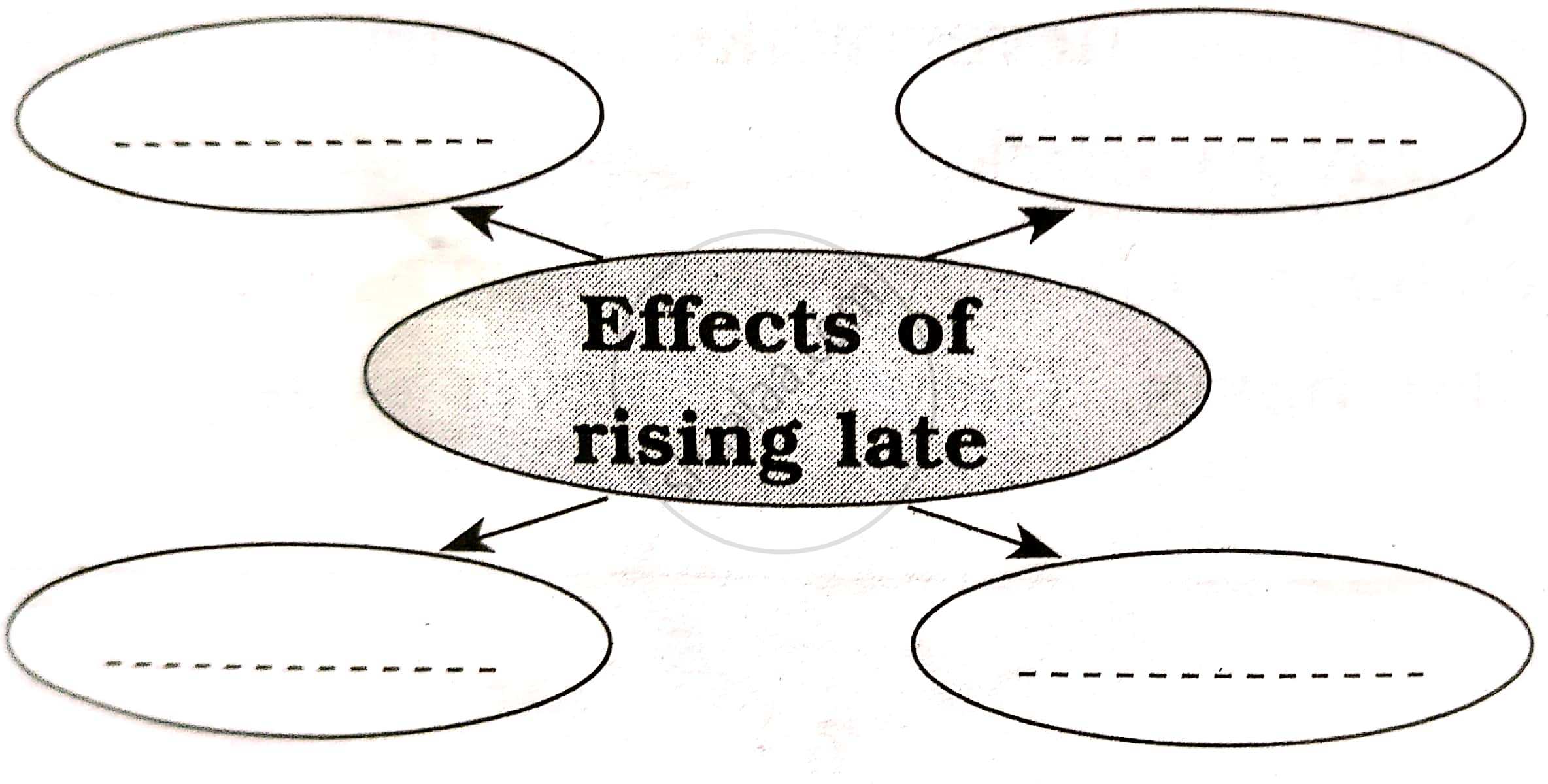
Some people can just never wake up early. They munch their breakfast on the way to work. They have excuses ready when they reach the office late. They miss trains on a regular basis. They have never seen a sunrise or met the milkman. Until a loved one turned over a new leaf recently, she was one such late riser. Try as she might, she couldn't help pressing the snooze button a hundred times before she finally got up. She felt terrible about this tendency but there was nothing she could do about it. Come morning, She would just not be able to shrug off the desire to sleep a while more. Only when divine intervention answered her prayers recently was she able to join the early bird's club. Another relative has no plans of joining this league through. She is rather unabashed about waking up past noon on a daily basis. To be fair, her husband is a media personality who typically arrives home from work past midnight. That does indeed give them sufficient justification to stay longer in slumberland each morning. This practice does lead to certain oddities through. He goes for his 'morning' walk at 1 pm, heatwaves, and appalled onlookers notwithstanding. They once returned from a night out only to meet the neighbour's son who was off on an early morning jog! Early risers clearly have the edge in life. By the time most of us wake up, they've been through their morning rituals, enjoyed their walk, had their tea and read the daily news. They're also likely to have made long-distance calls before dawn to those similarly inclined. Thus, by the time the sun warms up they're likely to have discussed all varieties of 'men, matters, and affairs' with a dozen people. |
A2. Web :
Complete the following web :
A3. Complete the following statement :
Early risers clearly have the edge in life, because -
(1)
(2)
A4. Vocabulary :
Match the words in column 'A' with their meanings in Column 'B'.
| Column 'A' | Column 'B' |
| (1) justification | (a) dismiss |
| (2) oddities | (b) sleep |
| (3) slumber | (c) strange things |
| (4) shrug off | (d) clarification |
A5. Personal Response:
State two things that you can do to join the early birds' club.
A6. Grammar:
Rewrite the following sentences in the ways instructed :
(1) She felt terrible about this tendency but there was nothing she could do about it. (Rewrite the sentence using 'although'.)
(2) They have never seen a sunrise or met the milkman. (Rewrite using 'neither ... nor'.)
Read the following passage and do the given activities.
A1. State whether the following statements are true or false:
i. The narrator writes comics.
ii. Sudhir qualified as a friend.
iii. The narrator met Sudhir in Dehra.
iv. Friendship is all about disintegration.
FRIENDSHIP IS ALL ABOUT DOING THINGS TOGETHER. IT MAY BE Climbing a mountain, fishing in a mountain stream, cycling along a country road, camping in a forest clearing or simply traveling together and sharing the experiences that a new place can bring.
On at least two of these counts, Sudhir qualified as a friend, albeit a troublesome one, given to involving me in his adolescent escapades.
I met him in Dehra soon after my return from England. He turned up at my room, saying he’d heard I was a writer and did I have any comics to lend him?
“I don’t write comics”, I said; but there were some comics lying around, leftover from my own boyhood collection. So I gave these to the lanky youth who stood smiling in the doorway, and he thanked me and said he’d bring them back. From my window, I saw him cycling off in the general direction of Dalanwala.
He turned up again a few days later and dumped a large pile of new-looking comics on my desk. “Here are all the latest”, he announced. “You can keep them for me. I’m not allowed to read comics at home”.
A2. Complete the web chart with the information from the passage:

A3. Find out four compound words from the passage.
A4. Do as directed:
i. I am not allowed to read comics at home.
(Pick out the infinitive)
ii. From my window, I saw him cycling.
(Use ‘when’ and rewrite the sentence)
A5. According to you, what are the qualities of a good friend?
Read the following extract and answer the questions given
below:
So what is a city? It's a dense amalgamation of buildings and people. A city must provide equity and also be sustainable. As an architect who has been closely connected with Delhi and its planning, my wish list is more about the direction we need to take
so that future generations don't end up living in chaotic dysfunctional cities.
The first requirement for a city is a pragmatic plan. Many of our cities such as Delhi and Bhubaneshwar and even Port Blair in the Andamans have reasonably good master plans. Many also have City Development Plans which have been made an essential
requirement to draw funds from the government's Urban Renewal Programme (JNNURM). But they should be updated frequently based on the changing needs of its people.
And let's not forget its citizens-they need to be more proactively involved when evolving master plans. But often, there's a lack of planning and inadequate implementation systems. This applies to all essential components of city-streets, public transport system, traffic management, affordable housing, cars and parking, drainage, water supply, sewerage, and garbage. Any deficiency in these will lead to poor quality cities which won't be able to handle the pressure of increased population and changing needs.
The second requirement of a good city is good social infrastructure such as parks and places for leisure such as river and sea fronts. It needs to preserve and protect its heritage.
(1) What does a city require to emerge as a good city?
(2) What is the second requirement of a good city?
(3) What are the basic requirements to draw funds from the government's-Urban Renewal programme (JNNURM)?
(4) What suggestions will you give to make your city ideal?
(5) Rewrite the following sentences in the ways instructed:
(i) It's a dense amalgamation of buildings and people.
(Rewrite it using 'as well as'.)
(ii) A city must provide equity and also be sustainable.
(Rewrite it using another modal auxiliary showing "advice".)
(iii) The first requirement for a city is a pragmatic plan.
(Frame a 'Wh' ·question to get the underlined part as an answer.)
(6) Match the words in column 'A' with their meaning in 'B':
| Column A | Column B |
| 1 pragmatic | 1 blend |
| 2 amalgamation | 2 fantastic |
| 3 realistic | |
| 4 ancient |
Read the extract and complete the activities given below :
Luxurious houses on the edge of a big city which one promoter sold with the tagline ‘‘Where Nature peeps through every window.’’ All the advantages of a modern lifestyle but with the added bonus of fresh air. But nature isn’t greenery alone; it also includes wild animals.
While the view from the picture windows was easy on the eye, occasionally, it made them gulp with nervousness. At dusk, wild cats leaped out of the adjoining forest on to the top of the peripheral walls and strolled nonchalantly. Sometimes, they lounged on ledges with their long tails swinging freely, oblivious of the many worried human eyes pinned on them. Their cold yellow aggressive eyes turned black as their pupils dilated with failing light.
Some Mumbaikars paid a lot of money to see leopards on safari in Africa. But to watch them from one’s own home was disconcerting. These predators were out of line, stepping off nature into the city. Why did the leopards not stay within the 100-square kilometre Sanjay Gandhi National Park? Perhaps, the leopards thought that if people could venture into nature to jog, walk and picnic, why couldn’t they hang around apartment blocks? If people could enjoy nature, couldn’t nature savour humanity’s offerings?
Capturing leopards is extraordinarily simple. These curious cats seem incapable of resisting a free meal, walking into baited traps without hesitation. The reason the felines are attracted to their residential community is prey : stray dogs that live on rubbish heaps. Taking care of the food source is the best course of action, the volunteers said.
A1. Rewrite the following sentences as per their occurrence in the extract :
- Instead of capturing leopards we can take care of their food.
- Leopards leave their habitat and enter the human habitat.
- Modern lifestyle and nature both attract the dwellers.
- Leopards can enjoy human surroundings by leaving nature.
A2. Complete the following sentences :
- Nature is a combination of ______ and ______
- The best of both the worlds include ______ and ______
- The wild animals are out of line as ______
- The wild cats are attracted towards residential areas because ______
A3. Find out the words for leopards used in the extract :
- ____________
- ____________
- ____________
- ____________
A4. ‘‘If people could venture into nature to jog, walk, and picnic, why couldn’t the wild animals hang around apartment blocks?’’ Express your opinion.
A5. Rewrite the following sentences in the ways instructed :
- Taking care of the food source is the best course of action.
(Use infinitive form of the underlined word and rewrite.) -
Nature isn’t greenery alone; it also includes wild animals.
(Rewrite it by using ‘not only ... but also’.)
A6. Find a word for each of the following expressions from the extract :
- Enjoy the taste of something
- Embarrassing and confusing to watch
- Not conscious or aware of something or someone
- Relaxed and in an unworried manner
Read the following excerpt from a Case Study. J.K. Rowling - A Journey.
|
The story of Joanne Kathleen Rowling's near magical rise to fame is almost as well known as the characters she creates. Rowling was constantly writing and telling stories to her younger sister Dianne. "The first story I ever wrote down was about a rabbit called Rabbit." Rowling said in an interview. "He got measles and was visited by his friends including a giant bee called Miss Bee. And ever since Rabbit and Miss Bee, I have always wanted to be a writer, though I rarely told anyone so. However, my parents, both of whom come from impoverished backgrounds and neither of whom had been to college, took the view that my overactive imagination was an amusing personal quirk that would never pay a mortgage or secure a pension. A writer from the age of six, with two unpublished novels in the drawer, she was stuck on a train when Harry walked into her mind fully formed. She spent the next five years constructing the plots of seven books, one for every year of his secondary school life. Rowling says she started writing the first book, Harry Potter and the Sorcerer's Stone, in Portugal, where she was teaching English. At first nobody wanted to publish Harry Potter. She was told that plot was too complex. Refusing to compromise, she found a publisher. In 1997 Rowling received her first royalty cheque. By book three, she had sky rocketed to the top of the publishing world. A row of zeroes appeared on the author's bank balance and her life was turned upside down. Day and night she had journalists knocking on the unanswered door of her flat. Rowling's quality control has become legendary, as her obsession with accuracy. She's thrilled with Stephen Fry's taped version of the books and outraged that an Italian dust jacket showed Harry minus his glasses. "Don't they understand that the glasses are the clue to his vulnerability." Annual earnings of J.K. Rowlin from 2010 to 2019
|

On the basis of your understanding of the passage answer any five of the six questions given below. (5)
- Explain J. K. Rowling's 'near magical rise to fame'.
- What reason did the publishers give for rejecting Rowling's book?
- What was the drawback of achieving fame?
- Why was Rowling outraged with the Italian dust jacket?
- Find a word in the last para that means the same as 'insecure/helpless'.
- According to the graph, how many years did it take Rowling to become very successful?
Read the passage given below:
| (1) | Ratan, a global brand in Dairy products, works on a business model popularly known as, 'The Ratan Model'. This model aims to provide value for money to the customers and protect the interests of farmers simultaneously. | ||||||||||
| (2) | The Ratan model is a three-tiered structure that is implemented in its Dairy production: Firstly, Ratan acts as a direct link between milk producers and consumers that removes the middlemen. Secondly, farmers (milk producers) control procurement, processing and marketing. Thirdly, it is a professionally managed organization. | ||||||||||
| (3) | One can understand the Ratan Model better by taking cognizance of 'Ratan's Target Audience', where it has targeted the mass market of India with no premium offerings and works on providing the best quality products at affordable prices. | ||||||||||
| (4) | So Ratan formulates its pricing policy on the low cost price strategy which has attracted a lot of customers in the past and it continues to do so. | ||||||||||
| (5) | Another stance used by Ratan's Target Audience is based on customer-wise targeting and industry wise targeting. This strategy divides the target audience on the following two bases : | ||||||||||
| (6) |
The above table showcases how Ratan has a diversified customer base. |
||||||||||
| (7) | Industry Based Target Audience: Ratan has segmented milk for various industries such as ice-cream manufacturers, restaurants, coffee shops, and many similar industries. Further, it has segmented butter, ghee and cheese for bakeries, snack retailers, confectioneries, and many more. | ||||||||||
| (8) | The target audience study tells us that Ratan has a strong presence in both Business to Business and Businessto-Customers. | ||||||||||
| (9) | Ratan's marketing campaigns and strategies are implemented in a very attractive way. For example, the story of the 'Ratan Girl' is a popular 'ad' icon. It is a hand drawn cartoon of a young girl. | ||||||||||
Based on your understanding of the passage answer any Six out of the Seven questions given below:
- What does 'The Ratan Model' aim at?
- In dairy production how many tiers are there?
- Ratan acts as a direct link...? Explain.
- "Ratan Target audience is described as a diversified market. Explain with reference to the given table.
- Name the two basis on which Ratan divides the target audience.
- In which two spheres does Ratan have a strong presence?
- Which is the most loved ad icon of Ratan?
Read the following passage.
| A | Dirshti was young woman who had always been fascinated by the supernatural. She had read countless books and watched numerous documentaries about ghosts and otherworldly beings. So, when she heard about an abandoned hotel on the outskirts of town that was said to be haunted, she knew she had to investigate. |
| B | One night, Dirshti decided to sneak into the dilapidated hotel with a few of her friends. As they made their way through the dark, eerie corridors, they heard strange noises and felt cold spots. They were convinced that they were not alone. |
| C | Suddenly, they came across a room that was different from the rest. It was filled with old cooking equipment and strange symbols etched into the walls. Drishti felt a chill run down her spine as she entered the room. She knew that this was where the most paranormal activity occurred. As they were examining the room, they heard a loud bang coming from the hallway. They froze in fear, not knowing what was coming their way. They could hear footsteps approaching, and they knew they had to hide. |
| D | They quickly ducked behind some old shelves as the footsteps grew louder. The sound of breathing was getting closer and closer until finally, they saw a figure appear in the doorway. It was a man wearing a chef’s hat, with a face that was twisted in a sinister smile. Drishti and her friends felt their blood run cold as the man approached them. They could feel his cold breath on their faces as he leaned in, whispering in a deep voice, "You shouldn't be here." |
| E | Dirshti and her friends were frozen with fear as they stared into the chef's eyes. But suddenly, the lights flickered on and the figure disappeared. They looked around the room, and everything seemed normal. They had been so scared that they hadn't realized they were in a room with faulty wiring |
| F | Disappointed, they realized that their ghost hunt had been a bust. They left the hotel feeling deflated and let down. They had hoped for an exciting, spine-tingling adventure, but all they got was a scary moment caused by faulty wiring. As they drove home, they couldn't help but feel foolish for getting so worked up over nothing. They had been so convinced that they would find evidence of the paranormal that they had overlooked the simple explanation for the noises they had heard. |
| G | Dirshti learned an important lesson that night. Sometimes, the scariest things are the ones that we create in our own minds. She realized that she didn't need to chase after the supernatural to experience thrills and excitement. The world around her was full of mystery and wonder, and she was content to experience it without the need for ghosts and ghouls. |
Answer the following questions, based on the passage above.
(i) How does the setting contribute to the overall mood and atmosphere of the story? (1)
-
- It creates a sense of nostalgia.
- It provides a sense of false security.
- It adds to the suspense in the story.
- It presents a contrast with the real world.
(ii) List two ways, how the disappointment that Drishti and her friends felt after their ghost hunt is analogous to the feeling of waking up from a dream. Answer in 30 -40 words. (2)
(iii) What is the main flaw in Drishti's approach to investigating the haunted hotel? (1)
- She was too focused on finding evidence of the paranormal.
- She was too skeptical and refused to believe in the possibility of ghosts.
- She relied too heavily on other people's accounts of the supernatural.
- She didn't take enough precautions to ensure her safety.
(iv) After which paragraph of the story, would the following paragraph most likely be placed? (1)
They commenced walking through the hotel, Drishti’s torchlight barely illuminating the darkness around her. Suddenly, they heard a loud creaking noise behind them. Drishti whipped around, pointing her flashlight in the direction of the noise. Nothing. Shaken, they all quickened their pace.
(v) Briefly explain (in 30-40 words) any two elements that classify the story as scary (2)
(vi) Substitute the underlined word in the following sentence with a word/ phrase from paragraphs 4- 6, that means the same. (1)
The sound of the footsteps outside the door left her petrified and the rasping breathing added to her horror.
(vii) What is the most significant lesson that Drishti learns from her experience in the haunted hotel? (1)
- The importance of avoiding risk-taking.
- The need to be more sceptical of the supernatural.
- The value of evaluating your weaknesses
- The power of imagination to create suspense.
(viii) Complete the following appropriately. (1)
Based on the use of the word "dilapidated" to describe the hotel in Paragraph 2, we can infer that its condition was ______.
(ix) Complete the sentence appropriately. (1)
If the title, The Hotel Haunting is given to this passage, it would be an inappropriate title, as compared to The Unsettling Encounter at the Abandoned Hotel because ______.
(x) State whether the given assertion is TRUE or FALSE. (1)
The reason Drishti and her friends visited the abandoned hotel was to prove the existence of ghosts.
Read the following text.
| (1) | Reduction in green areas has caused various environmental problems. People squeezed between concrete structures are looking for various ways to meet their longing for green. One of the ways to do so, is vertical gardens and green walls. Vertical gardening is a unique method of gardening where plants are grown in a vertical position or upward, rather than in the traditional method of planting them on the ground. | ||||||||||||||||||||||||||||||||||||||||||||||||||||||||||||||||||||||||||||||||||||||||||||||||||||||||||||||||||||||||||||||
| (2) | The purpose of vertical gardens and green walls, which arises from the studies of different disciplines (landscape architects, architects, engineers, etc.), is to close the cold image of concrete and increase the visual value. In these systems, nature and structures are integrated, and thus, urban areas and the desired environment have become intertwined. | ||||||||||||||||||||||||||||||||||||||||||||||||||||||||||||||||||||||||||||||||||||||||||||||||||||||||||||||||||||||||||||||
| (3) | Vertical garden case studies often show that, though functionality should be in the foreground when vertical gardens are planned, they are generally made as aesthetic elements in the city's underpasses and city squares and decorative elements in residences without seeking functionality. | ||||||||||||||||||||||||||||||||||||||||||||||||||||||||||||||||||||||||||||||||||||||||||||||||||||||||||||||||||||||||||||||
| (4) | Experts support that the visual quality and evaluation of landscape architecture are determined based on the satisfaction of the users. Hence, a survey questionnaire was prepared for residents of varied age groups from of a metropolitan city. The given Table 1, displays these responses: | ||||||||||||||||||||||||||||||||||||||||||||||||||||||||||||||||||||||||||||||||||||||||||||||||||||||||||||||||||||||||||||||
|
|||||||||||||||||||||||||||||||||||||||||||||||||||||||||||||||||||||||||||||||||||||||||||||||||||||||||||||||||||||||||||||||
| (5) | The study acknowledged that vertical gardening has the potential to transform urban spaces into green, sustainable areas, and further research should explore the impact of vertical gardening on the environment and human well-being. | ||||||||||||||||||||||||||||||||||||||||||||||||||||||||||||||||||||||||||||||||||||||||||||||||||||||||||||||||||||||||||||||
Answer the following questions, based on the passage above.
i. Complete the following analogy appropriately, based on your understanding of paragraphs 1 & 2. (1)
We can say that the situation of people living in concrete structures is comparable with a fish living in a fishbowl, and the need for vertical gardens to the need for decorations in the fishbowl because ______.
ii. Fill the blanks with the appropriate option from those given in brackets, based on your understanding of paragraph 2. (1)
The statement that urban spaces have become more closely connected with the desired natural surroundings through the incorporation of nature and structures in vertical gardens and green walls is a _______ (fact/ opinion) because it is a _______ (subjective judgement/ objective detail).
iii. Justify the following, in about 40 words. (2)
While the survey results suggest that vertical gardens may be effective in improving the quality of life in urban areas, further research and evaluation may be necessary to fully understand their effectiveness and potential drawbacks.
iv. Based on the survey results, which two concerns should a city government, looking to install vertical gardens, address? (1)
v. In Table 1, statement 3, "Vertical gardens increase air quality - indoors and outdoors," received the most neutral responses from participants, with 51 respondents indicating a neutral stance. State any one inference that can be drawn from this. (1)
vi. Select the option that correctly displays what ‘intertwined’ signifies. (Reference-Paragraph 2) (1)
 |
 |
 |
 |
 |
| (i) | (ii) | (iii) | (iv) | (v) |
- (i), (iv) and (v)
- Only (ii)
- Only (iii)
- (ii) and (v)
vii. Infer one benefit and one drawback of vertical gardening in comparison to other solutions, such as community gardens or parks. (Answer in about 40 words) (2)
viii. Which of the following is the main takeaway from the study mentioned in the passage? (1)
- Vertical gardening has minimal impact on the environment or human well-being.
- Vertical gardening is a sustainable practice that can transform urban spaces into green areas.
- The impact of vertical gardening on the environment and human well-being has already been thoroughly explored.
- The study needs to include experts from horticultural firms to offer any recommendations for further research.
