Advertisements
Advertisements
Question
Read the following passage and do the activities:
(A1) Relate the following actions with the king and the hermit: (2)
| digging | learning things | breathe heavily | asking questions |
| King | Hermit |
| 1.______ | 1.______ |
| 2.______ | 2.______ |
|
When the king arrived, the hermit was digging the ground in front of his hut. He greeted the king but went on digging. The hermit was frail and weak, and each time he struck the ground with the spade and turned over a little earth, he breathed heavily. The king went up to him and said, “I have come to you, wise hermit, to ask you to answer three questions - How can I learn to do the right thing at the right time? Who are the people I most need, and to whom should I, therefore, pay most attention? And what affairs are the most important and need my first attention?” The hermit listened to the king but said nothing. He just spat on his hand and resumed digging. The king watched in silence for a while. Then, feeling sorry for the hermit, he said, “You are tired, let me take the spade and work awhile for you.” The hermit silently handed over the spade and sat down on the ground. When he had dug two beds, the king stopped and repeated his questions. |
(A2) State whether you agree/disagree with the following statements: (2)
- The hermit was strong and agile.
- The king came to the hermit to ask three questions.
- The hermit handed over the spade and sat down.
- The king wasn’t feeling sorry for the hermit.
(A3) Solve the cross word puzzle using words from the passage referring to the clues are given: (2)
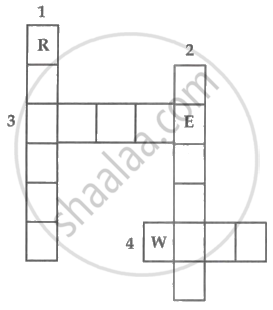
| Down | Across |
| (1) Restart/Start again | (3) A tool for digging |
| (2) Sage |
(4) Intelligent |
(A4) Do as Directed: (2)
- When the king arrived the hermit was digging the ground.
(Name and identify the subordinate clause.) - The hermit listened to the king but said nothing.
(Rewrite the sentence and begin it with “Though …...)
(A5) Whom do you consider your guide when you are in difficulty? Why? (2)
Advertisements
Solution
(A1)
| King | Hermit |
| 1. learning things | 1. digging |
| 2. asking questions | 2. breathe heavily |
(A2)
- Disagree
- Agree
- Agree
- Disagree
(A3)
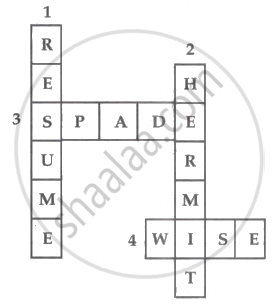
(A4)
- The hermit was digging the ground – main clause
When the king arrived – Subordinate adverb clause of time - Though the hermit listened to the king, he said nothing.
(A5)
I consider my mom as my guide in my difficulties because my mom always guides me to the right path. She is my motivator and I can share all my sorrows and happiness with my mom. I also confess my mistakes and she guides me toward doing the right thing. A mother is always trustworthy and being in her embrace and harboring good thoughts is always a pleasure. She does not let me deviate. Thus my mom is my guide, my future, my inspiration, and my motivator.
APPEARS IN
RELATED QUESTIONS
Read the following passage and do the activities.
He decided, instead to go to a hermit who was widely renowned for his wisdom. The hermit lived in a small hut in a forest which he never left. He spoke only to common folk. So the king put on simple clothes and approaching the hermit’s cell, dismounted his horse and left his bodyguard behind.
When the king arrived, the hermit was digging the ground in front of his hut. He greeted the king but went on digging. The hermit was frail and weak, and each time he struck the ground with the spade and turned over a little earth, he breathed heavily. The king went up to him and said, “I have come to you, wise hermit, to ask you to answer three questions-How can I learn to do the right thing at the right time? Who are the people I most need, and to whom should I, therefore, pay most attention ? And what affairs are the most important and need my first attention?”
The hermit listened to the king but said nothing. He just spat on his hand and resumed digging. The king watched in silence for a while. Then, feeling sorry for the hermit, he said, “You are tired, let me take the spade and work a while for you.” The hermit silently handed over the spade and sat down on the ground. When he had dug two beds, the king stopped and repeated his questions. The hermit again gave no answer, but rose, stretched out his hand for the spade, and said, “Now rest a while and let me work a bit”. But the king did not give him the spade and continued to dig.
One hour passed and another. The sun began to sink behind the trees and the king at last stuck the spade into the ground and said, “I came to you, wise one, for an answer to my questions. If you can give me none, please say so, and I will go home.’’ “Here comes someone running,’’ said the hermit, “let us see who it is.
(B1) State whether the following statements are True or False.
(a) The hermit answered all the questions.
(b) The hermit was strong and firm.
(c) The king had come to hermit to ask him answers of seven questions.
(d) The king felt sorry for the hermit after watching him tired.
(B2) Why did the king come to the hermit? How did the hermit respond to the king’s questions?
(B3) Find out two present participles and two past participles.
(B4)
(1) You are very tired.
(The correct exclamatory form of the sentence is …………..)
(i) How are you tired !
(ii) How tired you are !
iii) How you are tired !
(2) The hermit gave no answer. (Make it affirmative.)
(B5) Whom will you consult if you have any doubt or question in your mind? Why?
Expressions in English classified under different heads. Pair up with your partner, guess, and match the columns. (Use a dictionary.)
| A | B | |
| (1) Principle | (a) | a generally accepted, evident, truth |
| (2) Quotation | (b) | short striking messages for the public |
| (3) Moral | (c) | a short witty remark stating the truth |
| (4) Idioms | (d) | a popular, well-known truth |
| (5) Slogans | (e) | established expressions which do not convey exactly the same as individual words |
| (6) One-liners | (f) | words cited from a speech/text of a famous person |
| (7) Maxims | (g) | a lesson derived from a story or experience |
| (8) Proverb | (h) | a rule to govern one’s behaviour |
Read the polite request/suggestion and complete the gaps in the responses. Make sure they are polite and not repeated.
| Is it alright if I use your laptop? | Accept (1) ____________ Refuse (2) ____________ |
The character traits of the king and hermit are mixed up. Sort them out in the right box.
| feeble | helpful | enlightened |
| impatient | eager to succeed | wise |
| patient | convincing |
| KING | HERMIT |
|
_______________ _______________ _______________ _______________ |
_______________ _______________ _______________ _______________ |
Choose the correct answer and fill in the blank.
“Varied” (Paragraph-3) means ______________.
Choose the correct answer and fill in the blank.
Many learned people came to the court and gave ________________.
Choose the correct answer and fill in the blank.
Choose an adverb that collocates with “breathed _______________.
Answer the following question.
Though the hermit did not say anything to the king for some time, he did not ignore the king or treat him rudely in any way. Do you agree? What evidence of his politeness can you point out? What shows that he listened and responded to the king’s words?
Answer the following question.
Do you think the hermit knew, beforehand, not only about the king’s arrival but about the ambush by his enemy? Think a little about this and say what you really feel.
Write down in your notebook two points for the following. How do you know?
the learned advisers who came to the court confused the king.
