Advertisements
Advertisements
Question
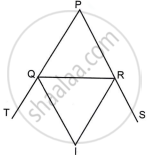
QI and RI bisect exterior angles RQT and QRS. Prove that `∠QIR = 90^circ - 1/2 ∠P`.
Advertisements
Solution
Given: In a triangle △PQR, let QI and RI bisect the exterior angles ∠RQT and ∠QRS respectively.
Prove that: `∠QIR = 90^circ - 1/2 ∠P`
Step 1: Understand the figure
1. △PQR
2. Let I be the intersection of the bisectors of the exterior angles at Q and R
QI bisects exterior angle at Q ...(∠RQT)
RI bisects exterior angle at R ...(∠QRS)
3. ∠QIR is the angle formed at I by these bisectors.
Step 2: Recall properties of exterior angle bisectors
The exterior angle at a vertex of a triangle:
Exterior angle = 180° – Interior angle
If a line bisects an exterior angle, it forms an angle with the side of the triangle that is:
`1/2 ("Exterior angle")`
= `1/2 (180^circ - "Interior angle")`
= `90^circ - 1/2 ("Interior angle")`
Step 3: Apply to vertices Q and R
Let ∠Q = ∠PQR
Let ∠R = ∠PRQ
Let ∠P = ∠QPR
Exterior angles:
1. At Q: ∠RQT = 180° – ∠Q
2. At R: ∠QRS = 180° – ∠R
Their bisectors:
1. `∠IQX = 1/2 (180^circ - ∠Q) = 90^circ - 1/2 ∠Q`
2. `∠IRY = 1/2 (180^circ - ∠R) = 90^circ - 1/2 ∠R`
Step 4: Consider triangle formed by intersection I
At I, the angle ∠QIR is opposite angle P of triangle PQR because of the triangle’s angle sum property.
Property: In a triangle, if two lines bisect the exterior angles at two vertices, the angle formed at their intersection is:
`∠QIR = 180^circ - (90^circ + 1/2∠Q) - (90^circ + 1/2∠R)`
Angles between the bisectors at I:
∠QIR = 180° – (∠IQX + ∠IRY)
`∠QIR = 180^circ - (90^circ - 1/2∠Q) + (90^circ - 1/2∠R)`
`∠QIR = 180^circ - (180^circ - 1/2∠Q - 1/2∠R)`
`∠QIR = 1/2∠Q + 1/2∠R`
Step 5: Use triangle angle sum
∠P + ∠Q + ∠R = 180°
∠Q + ∠R = 180° – ∠P
`∠QIR = 1/2(180^circ - ∠P)`
`∠QIR = 90^circ - 1/2∠P`
