Advertisements
Advertisements
Question
Prove the theorem of perpendicular axes.
(Hint: Square of the distance of a point (x, y) in the x–y plane from an axis through the origin perpendicular to the plane is x2 + y2).
Advertisements
Solution 1
The theorem of perpendicular axes states that the moment of inertia of a planar body (lamina) about an axis perpendicular to its plane is equal to the sum of its moments of inertia about two perpendicular axes concurrent with the perpendicular axis and lying in the plane of the body.
A physical body with centre O and a point mass m,in the x–y plane at (x, y) is shown in the following figure.

Moment of inertia about x-axis, Ix = mx2
Moment of inertia about y-axis, Iy = my2
Moment of inertia about z-axis, Iz = `m(sqrt(x^2 + y^2))^2`
Ix + Iy = mx2 + my2
= m(x2 + y2)
`= m(sqrt(x^2 + y^2))`
`I_x + I_y = I_z`
Hence the theorem is proved
Solution 2
The theorem of perpendicular axes: According to this theorem, the moment of inertia of a plane lamina (i.e., a two dimensional body of any shape/size) about any axis OZ perpendicular to the plane of the lamina is equal to sum of the moments of inertia of the lamina about any two mutually perpendicular axes OX and OY in the plane of lamina, meeting at a point where the given axis OZ passes through the lamina. Suppose at the point ‘R’ m{ particle is situated moment of inertia about Z axis of lamina
= moment of inertia of body about r-axis
= moment of inertia of the body about y-axis.

RELATED QUESTIONS
State an expression for the moment of intertia of a solid uniform disc, rotating about an axis passing through its centre, perpendicular to its plane. Hence derive an expression for the moment of inertia and radius of gyration:
i. about a tangent in the plane of the disc, and
ii. about a tangent perpendicular to the plane of the disc.
Prove the theorem of parallel axes about moment of inertia
State Brewster's law.
Prove the theorem of parallel axes.
(Hint: If the centre of mass is chosen to be the origin `summ_ir_i = 0`
Answer in brief:
State the conditions under which the theorems of parallel axes and perpendicular axes are applicable. State the respective mathematical expressions.
State and explain the theorem of parallel axes.
When a 12000 joule of work is done on a flywheel, its frequency of rotation increases from 10 Hz to 20 Hz. The moment of inertia of flywheel about its axis of rotation is ______. (π2 = 10)
A circular disc 'X' of radius 'R' made from iron plate of thickness 't' has moment of inertia 'Ix' about an axis passing through the centre of disc and perpendicular to its plane. Another disc 'Y' of radius '3R' made from an iron plate of thickness `("t"/3)` has moment of inertia 'Iy' about the s same as that of disc X. The relation between Ix and ly is ______.
A wheel of moment of inertia 2 kg m2 is rotating at a speed of 25 rad/s. Due to friction on the axis, it comes to rest in 10 minutes. Total work done by friction is ______.
The moment of inertia of a uniform square plate about an axis perpendicular to its plane and passing through the centre is `"Ma"^2/6` where M is the mass and 'a' is the side of square plate. Moment of inertia of this plate about an axis perpendicular to its plane and passing through one of its corner is ______.
A uniform cylinder of mass M and radius R is to be pulled over a step of height a (a < R) by applying a force F at its centre 'O' perpendicular to the plane through the axes of the cylinder on the edge of the step (see figure). The minimum value of F required is:

Two particles A and B having equal charges are placed at a distance d apart. A third charged particle placed on the perpendicular bisection of AB at distance x. The third particle experiences maximum force when ______.
State and prove the theorem of the parallel axis about the moment of inertia.
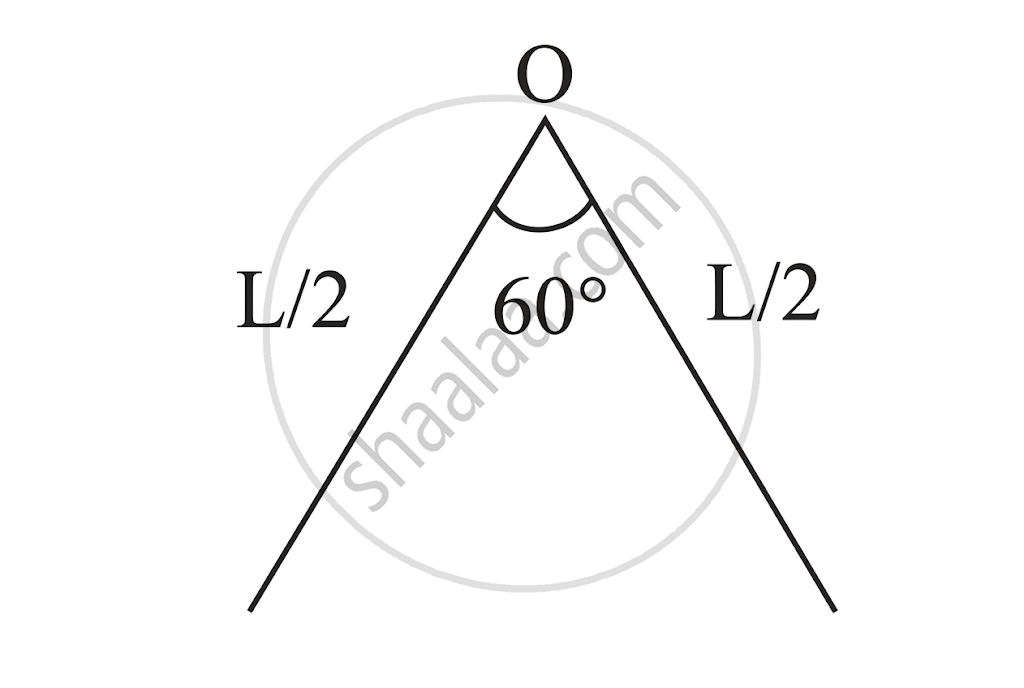
A thin rod of length 'L' and mass ‘M’ is bent at the middle point O at an angle of 60°. The moment of inertia of the rod about an axis passing through point 'O' and perpendicular to the plane of the rod will be ______.
A thin rod of length ‘4L’ and mass ‘4m’ is bent at the points as shown in the figure. The moment of inertia of the rod about an axis passing through point ‘O’ and perpendicular to plane of the paper is: