Advertisements
Advertisements
Question
Prove that the volume of a tetrahedron with coterminus edges `overlinea, overlineb` and `overlinec` is `1/6[(overlinea, overlineb, overlinec)]`.
Hence, find the volume of tetrahedron whose coterminus edges are `overlinea = hati + 2hatj + 3hatk, overlineb = -hati + hatj + 2hatk` and `overlinec = 2hati + hatj + 4hatk`.
Advertisements
Solution
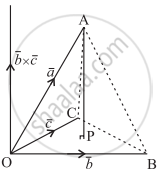
Let `overline(OA) = overlinea, overline(OB) = overlineb` and `overline(OC) = overlinec` be coterminus edges of tetrahedron OABC.
Let AP be the height of the tetrahedron.
Volume of tetrahedron = `1/3`(Area of base ΔOCB) (Height AP)
But AP = Scalar Projection of `overlinea` on `(overlineb xx overlinec)`
= `((overlineb xx overlinec).overlinea)/|overlineb xx overlinec|` ...`(∵ "scalar projection of" overlinep "on" overlineq "is" (overlinep.overlineq)/overlineq)`
Area of ΔOBC = `1/2 |overlineb xx overlinec|`
Volume of tetrahedron = `1/3 xx 1/2 |overlineb xx overlinec| ((overlineb xx overlinec).overlinea)/|overlineb xx overlinec|`
= `1/6 [(overlineb xx overlinec).overlinea]`
= `1/6[(overlinea, overlineb, overlinec)]`
Hence proved.
Now `overlinea = hati + 2hatj + 3hatk, overlineb = -hati + hatj + 2hatk` and `overlinec = 2hati + hatj + 4hatk`
∴ Volume of tetrahedron = `1/6[(overlinea, overlineb, overlinec)]`
= `1/6|(1, 2, 3),(-1, 1, 2),(2, 1, 4)|`
= `1/6 [1(4 - 2) - 2(-4 - 4) + 3(-1 - 2)]`
= `1/6 [1(2) - 2(-8) + 3(-3)]`
= `1/6 [2 + 16 - 9]`
= `1/6 [18 - 9]`
= `1/6 xx 9`
= `3/2`
= 1.5
Thus the Volume of tetrahedron is 1.5 cubic units.
APPEARS IN
RELATED QUESTIONS
If A, B, C, D are (1, 1, 1), (2, 1, 3), (3, 2, 2), (3, 3, 4) respectively, then find the volume of parallelopiped with AB, AC and AD as the concurrent edges.
Prove that the volume of a parallelopiped with coterminal edges as ` bara ,bar b , barc `
Hence find the volume of the parallelopiped with coterminal edges `bar i+barj, barj+bark `
If `bar c = 3bara- 2bar b ` Prove that `[bar a bar b barc]=0`
Prove that, for any three vector `veca,vecb,vecc [vec a+vec b,vec b+vec c,vecc+veca]=2[veca vecb vecc]`
Find λ, if the vectors `veca=hati+3hatj+hatk,vecb=2hati−hatj−hatk and vecc=λhatj+3hatk` are coplanar.
Find the value of λ, if four points with position vectors `3hati + 6hatj+9hatk`, `hati + 2hatj + 3hatk`,`2hati + 3hatj + hatk` and `4hati + 6hatj + lambdahatk` are coplanar.
Show that the four points A, B, C and D with position vectors `4hati + 5hatj + hatk`, `-hatj-hatk`, `3hati + 9hatj + 4hatk` and `4(-hati + hatj + hatk)` respectively are coplanar
Find the volume of a parallelopiped whose edges are represented by the vectors:
`vec a = 2 hat i - 3 hat j - 4 hat k`, `vec b = hat i + 2 hat j - hat k` and `vec c = 3 hat i + hat j + 2 hatk`
Prove that a necessary and sufficient condition for three vectors \[\vec{a}\], \[\vec{b}\], \[\vec{c}\] to be coplanar is that there exist scalars l, m, n not all zero simultaneously such that \[l \vec{a} + m \vec{b} + n \vec{c} = \vec{0} .\]
Evaluate the following:
\[\left[\hat{i}\hat{j}\hat{k} \right] + \left[ \hat{j}\hat{k}\hat {i} \right] + \left[ \hat{k}\hat{i} \hat{j} \right]\]
Find \[\left[ \vec{a} \vec{b} \vec{c} \right]\] , when \[\vec{a} = 2 \hat{i} - 3 \hat{j} , \vec{b} = \hat{i} + \hat{j} - \hat{k} \text{ and } \vec{c} = 3 \hat{i} - \hat{k}\]
Find the volume of the parallelopiped whose coterminous edges are represented by the vector:
\[\vec{a} = 11 \hat{i} , \vec{b} = 2 \hat{j} , \vec{c} = 13 \hat{k}\]
Find the volume of the parallelopiped whose coterminous edges are represented by the vector:
\[\vec{a} = \hat{i} + \hat{j} + \hat{k} , \vec{b} =\hat{ i} - \hat{j} + \hat{k} , \vec{c} = \hat{i} + 2 \hat{j} - \hat{k}\]
Show of the following triad of vector is coplanar:
\[\hat{a} = \hat{i} - 2 \hat {j} + 3 \hat {k} , \hat {b} = - 2 \hat {i} + 3 \hat {j} - 4 \hat { k}, \hat {c} = \hat { i} - 3 \hat { j} + 5 \hat { k }\]
Find the value of λ so that the following vector is coplanar:
\[\vec{a} = \hat {i} + 3 \hat {j} , \vec{b} = 5 \hat {k} , \vec{c} = \lambda \hat {i} - \hat {j}\]
\[\text {Let } \vec{a} = \hat {i} + \hat {j} + \hat {k} , \vec{b} = \hat {i} \text{and} \hat {c} = c_1 \hat{i} + c_2 \hat {j} + c_3 \hat {k} . \text {Then},\]
If c1 = 1 and c2 = 2, find c3 which makes \[\vec{a,} \vec{b} \text { and } \vec{c}\] coplanar.
Find the values of 'a' for which the vectors
\[\vec{\alpha} = \hat {i} + 2 \hat {j} + \hat {k} , \vec{\beta} = a \hat {i} + \hat {j} + 2 \hat {k} \text { and } \vec{\gamma} = \hat {i} + 2 \hat {j} + a \hat { k }\] are coplanar.
If \[\vec{a}\] lies in the plane of vectors \[\vec{b} \text { and } \vec{c}\], then which of the following is correct?
If \[\vec{a,} \vec{b,} \vec{c}\] are three non-coplanar mutually perpendicular unit vectors, then \[\left[ \vec{a} \vec{b} \vec{c} \right],\] is
For any three vectors \[\vec{a,} \vec{b,} \vec{c}\] the expression \[\left( \vec{a} - \vec{b} \right) . \left\{ \left( \vec{b} - \vec{c} \right) \times \left( \vec{c} - \vec{a} \right) \right\}\] equals
If \[\vec{a,} \vec{b,} \vec{c}\] are non-coplanar vectors, then \[\frac{\vec{a} \cdot \left( \vec{b} \times \vec{c} \right)}{\left( \vec{c} \times \vec{a} \right) \cdot \vec{b}} + \frac{\vec{b} \cdot \left( \vec{a} \times \vec{c} \right)}{\vec{c} \cdot \left( \vec{a} \times \vec{b} \right)}\] is equal to
Let \[\vec{a} = a_1 \hat { i }+ a_2 \hat {j} + a_3 \hat {k} , \vec{b} = b_1 \hat {i} + b_2 \hat { j } + b_3 \hat { k} \text { and } \vec{c} = c_1 \hat { i } + c_2 \hat{j } + c_3\text { k }\] be three non-zero vectors such that \[\vec{c}\] is a unit vector perpendicular to both \[\vec{a} \text { and } \vec{b}\]. If the angle between \[\vec{a} \text { and } \vec{b}\] is \[\frac{\pi}{6},\] , then
\[\begin{vmatrix}a_1 & a_2 & a_3 \\ b_1 & b_2 & b_3 \\ c_1 & c_2 & c_3\end{vmatrix}^2\] is equal to
\[\left[ \vec{a} \vec{b} \vec{a} \times \vec{b} \right] + \left( \vec{a} . \vec{b} \right)^2 =\]
For non-zero vectors \[\vec{a,} \vec{b} \text { and }\vec{c}\] the relation \[\left| \left( \vec{a} \times \vec{b} \right) \cdot \vec{c} \right| = \left| \vec{a} \right| \left| \vec{b} \right| \left| \vec{c} \right|\] holds good, if
If \[\vec{a,} \vec{b,} \vec{c}\] are three non-coplanar vectors, then \[\left( \vec{a} + \vec{b} + \vec{c} \right) . \left[ \left( \vec{a} + \vec{b} \right) \times \left( \vec{a} + \vec{c} \right) \right]\] equals
Find the volume of the parallelopiped, if the coterminus edges are given by the vectors `2hat"i" + 5hat"j" -4 hat"k", 5hat"i" +7hat"j"+5 hat "k" , 4hat"i" +5hat"j" - 2 hat"k"`.
Determine where `bb(bara)` and `bb(barb)` are orthogonal, parallel or neither.
`bara = -3/5hati + 1/2hatj + 1/3hatk , barb = 5hati + 4hatj + 3hatk`
If a vector has direction angles 45° and 60°, find the third direction angle.
If a line has the direction ratios 4, −12, 18, then find its direction cosines
Find the angle between the lines whose direction cosines l, m, n satisfy the equations 5l + m + 3n = 0 and 5mn − 2nl + 6lm = 0.
If the vectors `3hat"i" + 5hat"k", 4hat"i" + 2hat"j" - 3hat"k"` and `3hat"i" + hat"j" + 4hat"k"` are the coterminus edges of the parallelopiped, then find the volume of the parallelopiped.
Find the volume of the parallelepiped whose coterminous edges are represented by the vectors `- 6hat"i" + 14hat"j" + 10hat"k", 14hat"i" - 10hat"j" - 6hat"k"` and `2hat"i" + 4hat"j" - 2hat"k"`
If `vec"a", vec"b", vec"c"` are three non-coplanar vectors represented by concurrent edges of a parallelepiped of volume 4 cubic units, find the value of `(vec"a" + vec"b") * (vec"b" xx vec"c") + (vec"b" + vec"c")* (vec"c" xx vec"a") + (vec"c" + vec"a") * (vec"a" xx vec"b")`
Let `vec"a", vec"b", vec"c"` be three non-zero vectors such that `vec"c"` is a unit vector perpendicular to both `vec"a"` and `vec"b"`. If the angle between `vec"a"` and `vec"b"` is `pi/6`, show that `[(vec"a", vec"b", vec"c")]^2 = 1/4|vec"a"|^2|vec"b"|^2`
If the volume of tetrahedron whose vertices are A(0, 1, 2), B(2, -3, 0), C(1, 0, 2) and D(-2,-3,lambda) is `7/3` cu.units, then the value of λ is ______.
If `veca, vecb, vecc` are three non-coplanar vectors, then the value of `(veca.(vecb xx vecc))/((vecc xx veca).vecb) + (vecb.(veca xx vecc))/(vecc.(veca xx vecb))` is ______.
Determine whether `bara` and `barb` are orthogonal, parallel or neither.
`bara = - 3/5 hati + 1/2 hatj + 1/3 hatk, barb = 5hati + 4hatj + 3hatk`
Determine whether `bb(bara and barb)` are orthogonal, parallel or neither.
`bar a = -3/5hati + 1/2hatj + 1/3hatk, barb = 5hati + 4hatj + 3hatk`
If `barc = 3bara - 2barb` and `[bara barb + barc bara + barb + barc]` = 0 then prove that `[bara barb barc]` = 0
Determine whether `bara and barb` are orthogonal, parallel or neither.
`bara = -3/5hati + 1/2hatj +1/3 hatk, barb = 5hati + 4hatj +3hatk`
Determine whether `bara and barb` are orthogonal, parallel or neither.
`bara = -3/5 hati + 1/2 hatj + 1/3 hatk, barb = 5 hati + 4 hatj + 3 hatk`
Find the volume of a tetrahedron whose vertices are A(−1, 2, 3) B(3, −2, 1), C(2, 1, 3) and D(−1, −2, 4).
