Advertisements
Advertisements
प्रश्न
Prove that the volume of a tetrahedron with coterminus edges `overlinea, overlineb` and `overlinec` is `1/6[(overlinea, overlineb, overlinec)]`.
Hence, find the volume of tetrahedron whose coterminus edges are `overlinea = hati + 2hatj + 3hatk, overlineb = -hati + hatj + 2hatk` and `overlinec = 2hati + hatj + 4hatk`.
Advertisements
उत्तर
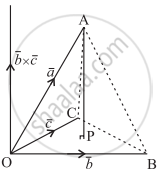
Let `overline(OA) = overlinea, overline(OB) = overlineb` and `overline(OC) = overlinec` be coterminus edges of tetrahedron OABC.
Let AP be the height of the tetrahedron.
Volume of tetrahedron = `1/3`(Area of base ΔOCB) (Height AP)
But AP = Scalar Projection of `overlinea` on `(overlineb xx overlinec)`
= `((overlineb xx overlinec).overlinea)/|overlineb xx overlinec|` ...`(∵ "scalar projection of" overlinep "on" overlineq "is" (overlinep.overlineq)/overlineq)`
Area of ΔOBC = `1/2 |overlineb xx overlinec|`
Volume of tetrahedron = `1/3 xx 1/2 |overlineb xx overlinec| ((overlineb xx overlinec).overlinea)/|overlineb xx overlinec|`
= `1/6 [(overlineb xx overlinec).overlinea]`
= `1/6[(overlinea, overlineb, overlinec)]`
Hence proved.
Now `overlinea = hati + 2hatj + 3hatk, overlineb = -hati + hatj + 2hatk` and `overlinec = 2hati + hatj + 4hatk`
∴ Volume of tetrahedron = `1/6[(overlinea, overlineb, overlinec)]`
= `1/6|(1, 2, 3),(-1, 1, 2),(2, 1, 4)|`
= `1/6 [1(4 - 2) - 2(-4 - 4) + 3(-1 - 2)]`
= `1/6 [1(2) - 2(-8) + 3(-3)]`
= `1/6 [2 + 16 - 9]`
= `1/6 [18 - 9]`
= `1/6 xx 9`
= `3/2`
= 1.5
Thus the Volume of tetrahedron is 1.5 cubic units.
APPEARS IN
संबंधित प्रश्न
Find λ, if the vectors `veca=hati+3hatj+hatk,vecb=2hati−hatj−hatk and vecc=λhatj+3hatk` are coplanar.
Find the volume of a tetrahedron whose vertices are A(−1, 2, 3), B(3, −2, 1), C(2, 1, 3) and D(−1, −2, 4).
Let `veca = hati + hatj + hatk = hati` and `vecc = c_1veci + c_2hatj + c_3hatk` then
1) Let `c_1 = 1` and `c_2 = 2`, find `c_3` which makes `veca, vecb "and" vecc`coplanar
2) if `c_2 = -1` and `c_3 = 1`, show that no value of `c_1`can make `veca, vecb and vecc` coplanar
if `bara = 3hati - 2hatj+7hatk`, `barb = 5hati + hatj -2hatk`and `barc = hati + hatj - hatk` then find `bara.(barbxxbarc)`
Evaluate the following:
\[\left[\hat{i}\hat{j}\hat{k} \right] + \left[ \hat{j}\hat{k}\hat {i} \right] + \left[ \hat{k}\hat{i} \hat{j} \right]\]
Find \[\left[ \vec{a} \vec{b} \vec{c} \right]\] , when \[\vec{a} = 2 \hat{i} - 3 \hat{j} , \vec{b} = \hat{i} + \hat{j} - \hat{k} \text{ and } \vec{c} = 3 \hat{i} - \hat{k}\]
Find the volume of the parallelopiped whose coterminous edges are represented by the vector:
\[\vec{a} = 2 \hat{i} + 3 \hat{j} + 4 \hat{k} , \vec{b} =\hat{ i} + 2 \hat{j} - \hat{k} , \vec{c} = 3 \hat{i} - \hat{j} + 2 \hat{k}\]
Find the value of λ so that the following vector is coplanar:
\[\vec{a} = \hat{i} - \hat{j} + \hat{k} , \vec{b} = 2 \hat {i} + \hat {j} - \hat {k} , \vec{c} = \lambda\hat { i} - \hat {j} + \lambda \hat {k}\]
Find the value of λ so that the following vector is coplanar:
\[\vec{a} = \hat{i} + 2\hat { j} - 3 \hat {k} , \vec{b} = 3 \hat{i} + \lambda \hat {j} + \hat {k} , \vec{c} = \hat {i} + 2 \hat {j} + 2 \hat {k}\]
\[\text {Let } \vec{a} = \hat {i} + \hat {j} + \hat {k} , \vec{b} = \hat {i} \text{and} \hat {c} = c_1 \hat{i} + c_2 \hat {j} + c_3 \hat {k} . \text {Then},\]
If c1 = 1 and c2 = 2, find c3 which makes \[\vec{a,} \vec{b} \text { and } \vec{c}\] coplanar.
\[\text {Let } \vec{a} = \hat {i} + \hat {j} + \hat {k} , \vec{b} = \hat {i} \text{ and } \hat {c} = c_1 \hat{i} + c_2 \hat {j} + c_3 \hat {k} . \text {Then},\]
If c2 = −1 and c3 = 1, show that no value of c1 can make \[\vec{a,} \vec{b}\text { and } \vec{c}\] coplanar.
If the vectors (sec2 A) \[\hat {i} + \hat {j} + \hat {k} , \hat {i} + \left( \sec^2 B \right) \hat {j} + \hat {k} , \hat {i} + \hat {j} + \left( \sec^2 C \right) \hat {k}\] are coplanar, then find the value of cosec2 A + cosec2 B + cosec2 C.
If \[\vec{a,} \vec{b,} \vec{c}\] are non-coplanar vectors, then find the value of \[\frac{\vec{a} \cdot \left( \vec{b} \times \vec{c} \right)}{\left( \vec{c} \times \vec{a} \right) \cdot \vec{b}} + \frac{\vec{b} \cdot \left( \vec{a} \times \vec{c} \right)}{\vec{c} \cdot \left( \vec{a} \times \vec{b} \right)}\].
The value of \[\left[ \vec{a} - \vec{b} , \vec{b} - \vec{c} , \vec{c} - \vec{a} \right], \text { where } \left| \vec{a} \right| = 1, \left| \vec{b} \right| = 5, \left| \vec{c} \right| = 3, \text { is }\]
If \[\vec{a,} \vec{b,} \vec{c}\] are three non-coplanar mutually perpendicular unit vectors, then \[\left[ \vec{a} \vec{b} \vec{c} \right],\] is
For any three vectors \[\vec{a,} \vec{b,} \vec{c}\] the expression \[\left( \vec{a} - \vec{b} \right) . \left\{ \left( \vec{b} - \vec{c} \right) \times \left( \vec{c} - \vec{a} \right) \right\}\] equals
Let \[\vec{a} = a_1 \hat { i }+ a_2 \hat {j} + a_3 \hat {k} , \vec{b} = b_1 \hat {i} + b_2 \hat { j } + b_3 \hat { k} \text { and } \vec{c} = c_1 \hat { i } + c_2 \hat{j } + c_3\text { k }\] be three non-zero vectors such that \[\vec{c}\] is a unit vector perpendicular to both \[\vec{a} \text { and } \vec{b}\]. If the angle between \[\vec{a} \text { and } \vec{b}\] is \[\frac{\pi}{6},\] , then
\[\begin{vmatrix}a_1 & a_2 & a_3 \\ b_1 & b_2 & b_3 \\ c_1 & c_2 & c_3\end{vmatrix}^2\] is equal to
If \[\vec{a} = 2\hat{ i} - 3 \hat { j} + 5 \hat { k} , \vec{b} = 3 \hat {i} - 4 \hat {j} + 5 \hat {k} \text { and } \vec{c} = 5\hat { i } - 3 \hat {j}- 2 \hat{k},\] then the volume of the parallelopiped with conterminous edges \[\vec{a} + \vec{b,} \vec{b} + \vec{c,} \vec{c} + \vec{a}\] is
If \[\left[ 2 \vec{a} + 4 \vec{b} \vec{c} \vec{d} \right] = \lambda\left[ \vec{a} \vec{c} \vec{d} \right] + \mu\left[ \vec{b} \vec{c} \vec{d} \right],\] then λ + μ =
For non-zero vectors \[\vec{a,} \vec{b} \text { and }\vec{c}\] the relation \[\left| \left( \vec{a} \times \vec{b} \right) \cdot \vec{c} \right| = \left| \vec{a} \right| \left| \vec{b} \right| \left| \vec{c} \right|\] holds good, if
Find the volume of the parallelopiped, if the coterminus edges are given by the vectors `2hat"i" + 5hat"j" -4 hat"k", 5hat"i" +7hat"j"+5 hat "k" , 4hat"i" +5hat"j" - 2 hat"k"`.
Find the value of p, if the vectors `hat"i" - 2hat"j" + hat"k", 2hat"i" -5hat"j"+"p" hat "k" , 5hat"i" -9hat"j" + 4 hat"k"` are coplanar.
Determine where `bar"a"` and `bar"b"` are orthogonal, parallel or neithe:
`bar"a" = 2hat"i" + 3hat"j" - hat"k"` , `bar"b" = 5hat"i" - 2hat"j" + 4hat"k"`
Determine where `bb(bara)` and `bb(barb)` are orthogonal, parallel or neither.
`bara = -3/5hati + 1/2hatj + 1/3hatk , barb = 5hati + 4hatj + 3hatk`
Prove by vector method, that the angle subtended on semicircle is a right angle.
If a vector has direction angles 45° and 60°, find the third direction angle.
The volume of the parallelepiped whose coterminus edges are `7hat"i" + lambdahat"j" - 3hat"k", hat"i" + 2hat"j" - hat"k", -3hat"i" + 7hat"j" + 5hat"k"` is 90 cubic units. Find the value of λ
Ler `vec"a" = hat"i" + hat"j" + hat"k", vec"b" = hat"i"` and `vec"c" = "c"_1hat"i" + "c"_2hat"j" + "c"_3hat"k"`. If c1 = 1 and c2 = 2. find c3 such that `vec"a", vec"b"` and `vec"c"` are coplanar
If the vectors `"a"hat"i" + "a"hat"j" + "c"hat"k", hat"i" + hat"k"` and `"c"hat"i" + "c"hat"j" + "b"hat"k"` are coplanar, prove that c is the geometric mean of a and b
Let `vec"a", vec"b", vec"c"` be three non-zero vectors such that `vec"c"` is a unit vector perpendicular to both `vec"a"` and `vec"b"`. If the angle between `vec"a"` and `vec"b"` is `pi/6`, show that `[(vec"a", vec"b", vec"c")]^2 = 1/4|vec"a"|^2|vec"b"|^2`
If the volume of tetrahedron whose vertices are A(0, 1, 2), B(2, -3, 0), C(1, 0, 2) and D(-2,-3,lambda) is `7/3` cu.units, then the value of λ is ______.
If the points having the position vectors `2hat"i" + hat"j" - hat"k", -hat"j", 4hat"i" + 4hat"k"` and `lambdahat"i" + hat"k"` lie on the same plane, then λ is equal to ______.
If the direction cosines of a line are `(1/c, 1/c, 1/c)` then ______.
If `veca, vecb, vecc` are three non-coplanar vectors, then the value of `(veca.(vecb xx vecc))/((vecc xx veca).vecb) + (vecb.(veca xx vecc))/(vecc.(veca xx vecb))` is ______.
Determine whether `bara and barb` are orthogonal, parallel or neither.
`bara = - 3/5 hati+ 1/2 hatj + 1/3 hatk , barb= 5hati + 4hatj + 3hatk`
Determine whether `bb(bara and barb)` are orthogonal, parallel or neither.
`bar a = -3/5hati + 1/2hatj + 1/3hatk, barb = 5hati + 4hatj + 3hatk`
If a vector has direction angles 45ºand 60º find the third direction angle.
Determine whether `bara and barb` is orthogonal, parallel or neither.
`bara = -3/5hati + 1/2hatj + 1/3hatk, barb = 5hati + 4hatj + 3hatk`
Find the volume of a tetrahedron whose vertices are A(−1, 2, 3) B(3, −2, 1), C (2, 1, 3) and D(−1, −2, 4).
Determine whether `bara and barb` are orthogonal, parallel or neither.
`bara = -3/5 hati + 1/2 hatj + 1/3 hatk, barb = 5 hati + 4 hatj + 3 hatk`
The magnitude of a vector which is orthogonal to the vector \[\hat{\mathrm{i}}+\hat{\mathrm{j}}+\hat{\mathrm{k}}\] and is coplanar with the vectors \[\hat{\mathrm{i}}+\hat{\mathrm{j}}+2\hat{\mathrm{k}}\] and \[\hat{\mathrm{i}}+2\hat{\mathrm{j}}+\hat{\mathrm{k}}\] is
