Advertisements
Advertisements
Question
Prove that the quadrilateral formed by joining the mid-points of consecutive sides of a rectangle is a rhombus.
Advertisements
Solution
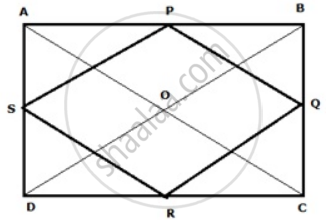
Let us join AC and BD
In ΔABC
P and Q are the mid-point of AB and DC respectively
Therefore, PQ || AC and PQ = `(1)/(2)"AC"`(mid-point theorem) ...(1)
Similarly in ΔADC
SR || AC and SR = `(1)/(2)"AC"`(mid-point theorem) .....(2)
Clearly, PQ || SR and PQ = SR
As in quadrilateral PQRS one pair of opposite sides is equal and parallel to each other, so, it is a parallelogram.
Therefore, PS || QR and PS = QR (opposite sides of parallelogram)... (3)
Now, in ΔBCD, Q and R are mid points of side BC and CD respectively.
Therefore, QR || BD and QR = `(1)/(2)"BD"`(mid-point theorem)...(4)
But diagonals of a rectangle are equal
⇒ AC = BD ...(5)
Now, by using equation (1). (2), (3), (4), (5) we can say that
PQ = QR = SR = PS
So, PQRS is a rhombus.
