Advertisements
Advertisements
Question
Prove that:
`(sin A + cos A)/(sin A - cos A) + (sin A - cos A)/(sin A + cos A) = 2/(2 sin^2 A - 1)`
Advertisements
Solution
LHS = `(sin A + cos A)/(sin A - cos A) + (sin A - cos A)/(sin A + cos A)`
= `((sin A + cos A)^2 + (sin A - cos A)^2)/((sin A - cos A)(sin A + cos A))`
= `(sin^2 A + cos^2 A + 2 sin Acos A + sin^2 A + cos^2 A - 2sin A. cos A)/(sin^2 A - cos^2 A)`
= `(2(sin^2A + cos^2 A))/(sin^2 A - cos^2 A)`
= `(2 xx 1)/(sin^2 A - (1- sin^2 A)`
= `2/(sin^2 A - 1+ sin^2 A)`
= `2/(2 sin^2 A - 1)`
= RHS
Hence proved.
APPEARS IN
RELATED QUESTIONS
Prove the following identities, where the angles involved are acute angles for which the expressions are defined:
`cos A/(1 + sin A) + (1 + sin A)/cos A = 2 sec A`
Prove the following identities:
`cosecA + cotA = 1/(cosecA - cotA)`
`cot theta/((cosec theta + 1) )+ ((cosec theta +1 ))/ cot theta = 2 sec theta `
Prove the following identities:
`("cosec" theta + cot theta)/("cosec" theta - cot theta) = ("cosec" theta + cot theta )^2 = 1 + 2 cot^2 theta + 2 "cosec" theta cot theta`
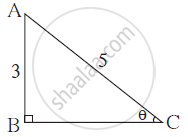
From the figure find the value of sinθ.
If cosec θ = 2x and \[5\left( x^2 - \frac{1}{x^2} \right)\] \[2\left( x^2 - \frac{1}{x^2} \right)\]
Prove the following identity :
( 1 + cotθ - cosecθ) ( 1 + tanθ + secθ)
Prove the following identity :
`(1 + sinA)/(1 - sinA) = (cosecA + 1)/(cosecA - 1)`
Find the value of x , if `cosx = cos60^circ cos30^circ - sin60^circ sin30^circ`
Prove that : `(sin(90° - θ) tan(90° - θ) sec (90° - θ))/(cosec θ. cos θ. cot θ) = 1`
