Advertisements
Advertisements
Question
Prove that in a ∆ABC, `sin"A"/"a" = sin"B"/"b" = sin"C"/"c"`, where a, b, c represent the magnitudes of the sides opposite to vertices A, B, C, respectively.
Advertisements
Solution
Let the three sides of the triangle BC, CA and AB be represented by `vec"a", vec"b"` and `vec"c"`, respectively .....[From the figure]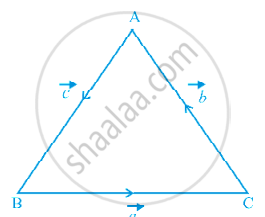
We have `vec"a" + vec"b" + vec"c"` = 0
i.e., `vec"a" + vec"b" = -vec"c"`
Which pre cross multiplying by `vec"a"`, and post cross multiplying by `vec"b"`, gives `vec"a" xx vec"b" = vec"c" xx vec"a"`
And `vec"a" xx vec"b" = vec"b" xx vec"c"` respectively.
Therefore `vec"a" xx vec"b" = vec"b" xx vec"c" = vec"c" xx vec"a"`
⇒ `|vec"a" xx vec"b"| = |vec"b" xx vec"c"|`
= `|vec"c" xx vec"a"|`
⇒ `|vec"a"||vec"b"|sin(pi - "C") = |vec"b"||vec"c"|sin(pi - "A")`
= `|vec"c"||vec"a"|sin(pi - "B")`
⇒ ab sin C = bc sinA = ca sinB
Dividing by abc, we get
`sin"C"/"c" = sin"A"/"a" = sin"B"/"b"`
i.e. `sin"A"/"a" = sin"B"/"b" = sin"C"/"c"`
