PQR is a triangle, S is a point on the side QR of (\triangle \mathrm{PQR}) such that (\angle \mathrm{PSR} = \angle \mathrm{QPR}). Given (\mathrm{QP} = 8 \mathrm{~cm}, \mathrm{PR} = 6 \mathrm{~cm})
Advertisements
Question
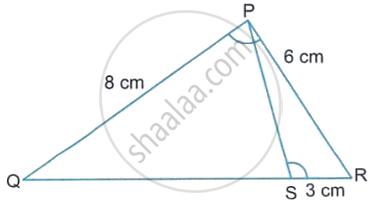
PQR is a triangle, S is a point on the side QR of \(\triangle \mathrm{PQR}\) such that \(\angle \mathrm{PSR} = \angle \mathrm{QPR}\).
Given \(\mathrm{QP} = 8 \mathrm{~cm}, \mathrm{PR} = 6 \mathrm{~cm}\) and \(\mathrm{SR} = 3 \mathrm{~cm}\).
- Prove \(\triangle \mathrm{PQR} \sim \triangle \mathrm{SPR}\)
- Find the length of QR and PS
- Find: \[\frac{\mathrm{area\ of}\ \triangle \mathrm{PQR}}{\mathrm{area\ of}\ \triangle \mathrm{SPR}}\]
Advertisements
Solution
Given: A triangle PQR with S on side QR such that \(\angle \mathrm{PSR} = \angle \mathrm{QPR}\), where \(\mathrm{QP} = 8 \mathrm{~cm}\), \(\mathrm{PR} = 6 \mathrm{~cm}\) and \(\mathrm{SR} = 3 \mathrm{~cm}\).
To prove:
- \(\triangle \mathrm{PQR} \sim \triangle \mathrm{SPR}\).
- Find QR and PS.
- Find the ratio of the areas of \(\triangle \mathrm{PQR}\) and \(\triangle \mathrm{SPR}\).
Proof:
AA-Axiom or AAA-Axiom: If two triangles have two pairs of corresponding angles equal, the triangles are similar.
- Since S lies on QR, rays RQ and RS coincide.
- Therefore, \(\angle \mathrm{QRP} = \angle \mathrm{SRP}\). [Angles with coincident arms]
- \(\angle \mathrm{QPR} = \angle \mathrm{PSR}\). [Given]
- Hence, \(\triangle \mathrm{PQR} \sim \triangle \mathrm{SPR}\). [By AA-Axiom of similarity]
- \(\frac{PQ}{SP} = \frac{QR}{PR} = \frac{PR}{SR}\). [Corresponding sides of similar triangles are proportional]
- \(\frac{PR}{SR} = \frac{6}{3} = 2\).
- \(QR = 2 \times PR = 2 \times 6 = 12\ \mathrm{cm}\).
- \(SP = \frac{PQ}{2} = \frac{8}{2} = 4\ \mathrm{cm}\).
Theorem 3: The areas of two similar triangles are proportional to the squares on their corresponding sides.
- \(\frac{\text{Area of } \triangle \mathrm{PQR}}{\text{Area of } \triangle \mathrm{SPR}} = \left(\frac{PR}{SR}\right)^2 = \left(\frac{6}{3}\right)^2 = 4\).
Thus, \(QR = 12\ \mathrm{cm}\), \(PS = 4\ \mathrm{cm}\) and \(\frac{\text{Area of } \triangle \mathrm{PQR}}{\text{Area of } \triangle \mathrm{SPR}} = 4\), that is \(4 : 1\).
Hence proved.
