Advertisements
Advertisements
Question
Plot the following points in the coordinate plane and join them. What is your conclusion about the resulting figure?
(−5, 3) (−1, 3) (0, 3) (5, 3)
Advertisements
Solution

Straight line parallel to x−axis.
APPEARS IN
RELATED QUESTIONS
Plot the points (x, y) given in the following table on the plane, choosing suitable units of distance on the axes.
| x | -2 | -1 | 0 | 1 | 3 |
| y | 8 | 7 | -1.25 | 3 | -1 |
Write the equation of the line parallel to the Y-axis at a distance of 7 units from it to its left.
Plot the following point in the coordinate system and identify the quadrant.
T(3, 9)
Write down the abscissa and ordinate of the following.
Q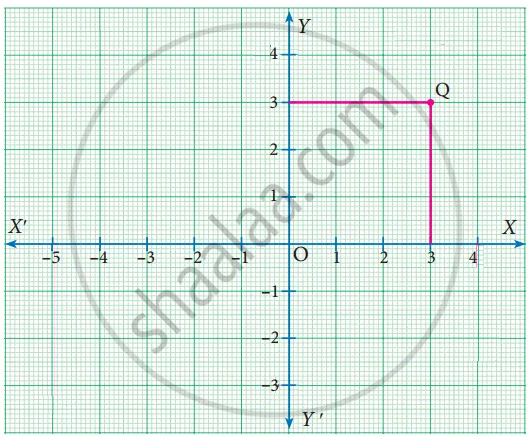
Write down the abscissa and ordinate of the following.
R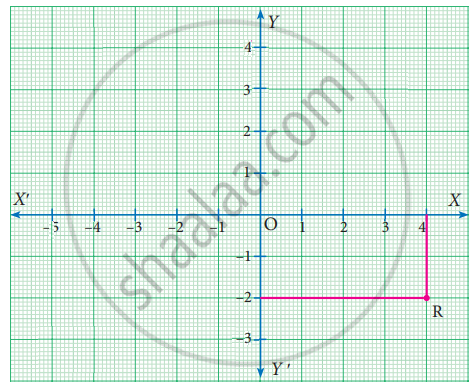
Plot the following points in the coordinate plane. Join them in order. What type of geometrical shape is formed?
(0, 0) (−4, 0) (−4, −4) (0, −4)
Find the quadrants without plotting the point on a graph sheet
(4, −3)
In the following figure, coordinates of P are ______.
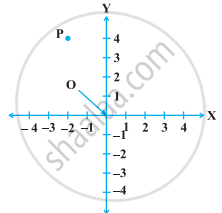
Plot the points (x, y) given by the following table. Use scale 1 cm = 0.25 units
| x | 1.25 | 0.25 | 1.5 | – 1.75 |
| y | – 0.5 | 1 | 1.5 | – 0.25 |
Points A(5, 3), B(– 2, 3) and D(5, – 4) are three vertices of a square ABCD. Plot these points on a graph paper and hence find the coordinates of the vertex C.
