Advertisements
Advertisements
Question
Plot a graph showing variation of de Broglie wavelength λ versus `1/sqrtV` , where V is accelerating potential for two particles A and B, carrying the same charge but different masses m1, m2 (m1 > m2). Which one of the two represents a particle of smaller mass and why?
Advertisements
Solution
Given: Charge (q) is the same but masses of both the particles are different (m1 > m2).
The de Brogile wavelength given by
`lambda = h/sqrt(2mqV)`
The slope of the graph λ versus `1/sqrtV `is `h/sqrt(2mq)`
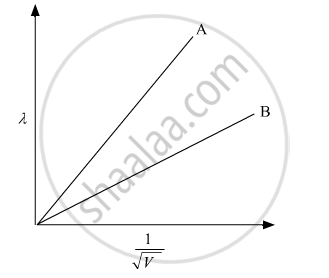
The slope of the smaller mass is larger; therefore, plot A in the above graph is for mass m2
RELATED QUESTIONS
An α-particle and a proton are accelerated through the same potential difference. Find the ratio of their de Broglie wavelength.
A proton and an electron have same velocity. Which one has greater de-Broglie wavelength and why?
An electron is accelerated through a potential difference of 64 volts. What is the de-Broglie wavelength associated with it? To which part of the electromagnetic spectrum does this value of wavelength correspond?
Find the de Broglie wavelength of electrons moving with a speed of 7 × 10⁶ ms -1.
Light of wavelength 2000 Å falls on a metal surface of work function 4.2 eV.
If the same light falls on another surface of work function 6.5 eV, what will be the energy of emitted electrons?
Two bodies A and B having masses in the ratio of 3 : 1 possess the same kinetic energy. The ratio of linear momentum of B to A is:
A solid sphere is in a rolling motion. In rolling motion, a body possesses translational kinetic energy (kt) as well as rotational kinetic energy (kr) simultaneously. The ratio kt : kr for the sphere is:
When the displacement of a particle executing simple harmonic motion is half of its amplitude, the ratio of its kinetic energy to potential energy is:
For an electron accelerated from rest through a potential V, the de Broglie wavelength associated will be:
What is meant by “Dual nature of matter”?
