Advertisements
Advertisements
प्रश्न
Plot a graph showing variation of de Broglie wavelength λ versus `1/sqrtV` , where V is accelerating potential for two particles A and B, carrying the same charge but different masses m1, m2 (m1 > m2). Which one of the two represents a particle of smaller mass and why?
Advertisements
उत्तर
Given: Charge (q) is the same but masses of both the particles are different (m1 > m2).
The de Brogile wavelength given by
`lambda = h/sqrt(2mqV)`
The slope of the graph λ versus `1/sqrtV `is `h/sqrt(2mq)`
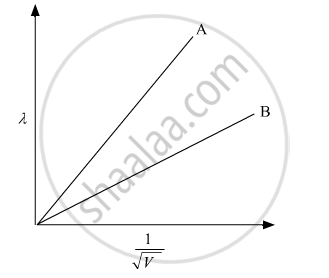
The slope of the smaller mass is larger; therefore, plot A in the above graph is for mass m2
संबंधित प्रश्न
A proton and an α -particle are accelerated through the same potential difference. Which one of the two has greater de-Broglie wavelength Justify your answer.
An α-particle and a proton are accelerated through the same potential difference. Find the ratio of their de Broglie wavelength.
Use de-Broglie's hypothesis to write the relation for the nth radius of Bohr orbit in terms of Bohr's quantization condition of orbital angular momentum ?
Consider the de-Broglie wavelength of an electron and a proton. Which wavelength is smaller if the two particles have (a) the same speed (b) the same momentum (c) the same energy?
Let p and E denote the linear momentum and energy of a photon. If the wavelength is decreased,
Find the de Broglie wavelength of electrons moving with a speed of 7 × 10⁶ ms -1.
Answer the following question.
Obtain the expression for the ratio of the de-Broglie wavelengths associated with the electron orbiting in the second and third excited states of the hydrogen atom.
The de- Broglie wave length of an electron moving with a speed of 6.6 × 10⁵ m/s is approximately
Number of ejected photo electrons increase with increase
What is meant by “Dual nature of matter”?
