Advertisements
Advertisements
Question
Find the smallest number by which 1152 must be divided so that it becomes a perfect square. Also, find the number whose square is the resulting number.
Advertisements
Solution
Prime factorisation of 1152:
1152 = 2 x 2 x 2 x 2 x 2 x 2 x 2 x 3 x 3
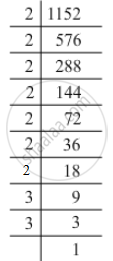
Grouping them into pairs of equal factors:
1152 = (2 x 2) x (2 x 2) x (2 x 2) x (3 x 3) x 2
The factor, 2 at the end is not paired. For a number to be a perfect square, each prime factor has to be paired. Hence, 1152 must be divided by 2 for it to be a perfect square.
The resulting number would be (2 x 2) x (2 x 2) x (2 x 2) x (3 x 3).
Furthermore, we have:
(2 x 2) x (2 x 2) x (2 x 2) x (2 x 2) x (3 x 3) = (2 x 2 x 2 x 3) x (2 x 2 x 2 x 3)
Hence, the number whose square is the resulting number is:
2 x 2 x 2 x 3 = 24
RELATED QUESTIONS
Which of the following numbers are perfect squares?
576
Which of the following numbers are perfect squares?
2500
Show that each of the following numbers is a perfect square. Also, find the numer whose square is the given number in each case:
2025
Which of the following numbers are perfect square?
79
Using prime factorization method, find which of the following numbers are perfect square?
343
By what numbers should each of the following be divided to get a perfect square ? Also, find the number whose square is the new number.
5103
13 and 31 is a strange pair of numbers such that their squares 169 and 961 are also mirror images of each other. Find two more such pairs.
The ones digit in the square of 77 is ___________
The square number of 5 is _________________________
A farmer wants to plough his square field of side 150 m. How much area will he have to plough?
