Advertisements
Advertisements
प्रश्न
Find the smallest number by which 1152 must be divided so that it becomes a perfect square. Also, find the number whose square is the resulting number.
Advertisements
उत्तर
Prime factorisation of 1152:
1152 = 2 x 2 x 2 x 2 x 2 x 2 x 2 x 3 x 3
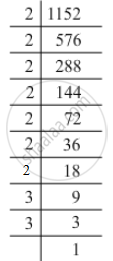
Grouping them into pairs of equal factors:
1152 = (2 x 2) x (2 x 2) x (2 x 2) x (3 x 3) x 2
The factor, 2 at the end is not paired. For a number to be a perfect square, each prime factor has to be paired. Hence, 1152 must be divided by 2 for it to be a perfect square.
The resulting number would be (2 x 2) x (2 x 2) x (2 x 2) x (3 x 3).
Furthermore, we have:
(2 x 2) x (2 x 2) x (2 x 2) x (2 x 2) x (3 x 3) = (2 x 2 x 2 x 3) x (2 x 2 x 2 x 3)
Hence, the number whose square is the resulting number is:
2 x 2 x 2 x 3 = 24
संबंधित प्रश्न
Which of the following numbers are perfect squares?
484
Which of the following numbers are perfect square?
50
By what number should each of the following numbers be multiplied to get a perfect square ? Also, find the number whose square is the new number.
8820
By what numbers should each of the following be divided to get a perfect square ? Also, find the number whose square is the new number.
16562
By what numbers should each of the following be divided to get a perfect square? Also, find the number whose square is the new number.
3698
By what numbers should each of the following be divided to get a perfect square ? Also, find the number whose square is the new number.
5103
Show that the following number is not perfect square:
4058
Show that the following number is not perfect square:
743522
There are ______ perfect squares between 1 and 100.
Find the side of a square whose area is equal to the area of a rectangle with sides 6.4 m and 2.5 m.
