Advertisements
Advertisements
Questions
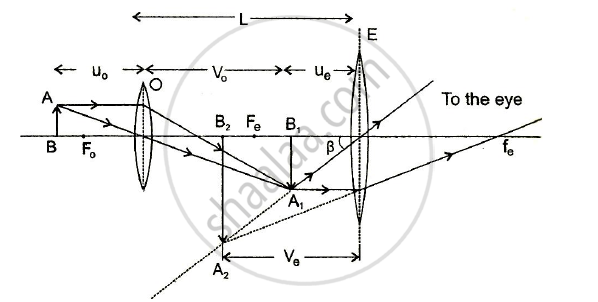
Draw a labelled ray diagram showing the formation of a final image by a compound microscope at least distance of distinct vision
Draw a ray diagram for the formation of image by a compound microscope
Advertisements
Solution 1
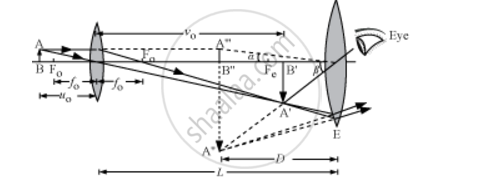
where, AB = object, A'B' = image formed by objective and A''B'' = image formed by eyepiece
fo = focal length of objective,
uo = object distance from objective
vo = image distance from objective
D = distance of least distinct vision
L = length of the microscope
Solution 2
APPEARS IN
RELATED QUESTIONS
How is 'limit of resolution' related to resolving power of a microscope ?
Draw a ray diagram showing the image formation by a compound microscope. Hence obtained expression for total magnification when the image is formed at infinity.
Draw a ray diagram to show the working of a compound microscope. Deduce an expression for the total magnification when the final image is formed at the near point.
In a compound microscope, an object is placed at a distance of 1.5 cm from the objective of focal length 1.25 cm. If the eye piece has a focal length of 5 cm and the final image is formed at the near point, estimate the magnifying power of the microscope.
A compound microscope forms an inverted image of an object. In which of the following cases it it likely to create difficulties?
Consider the following two statements :-
(A) Line spectra contain information about atoms.
(B) Band spectra contain information about molecules.
The separation between the objective and the eyepiece of a compound microscope can be adjusted between 9.8 cm to 11.8 cm. If the focal lengths of the objective and the eyepiece are 1.0 cm and 6 cm respectively, find the range of the magnifying power if the image is always needed at 24 cm from the eye
A lady uses + 1.5 D glasses to have normal vision from 25 cm onwards. She uses a 20 D lens as a simple microscope to see an object. Find the maximum magnifying power if she uses the microscope (a) together with her glass (b) without the glass. Do the answers suggest that an object can be more clearly seen through a microscope without using the correcting glasses?
What is the advantage of a compound microscope over a simple microscope?
A convex lens of a focal length 5 cm is used as a simple microscope. Where should an object be placed so that the image formed by it lies at the least distance of distinct vision (D = 25 cm)?
| A compound microscope consists of two converging lenses. One of them, of smaller aperture and smaller focal length, is called objective and the other of slightly larger aperture and slightly larger focal length is called eye-piece. Both lenses are fitted in a tube with an arrangement to vary the distance between them. A tiny object is placed in front of the objective at a distance slightly greater than its focal length. The objective produces the image of the object which acts as an object for the eye-piece. The eye-piece, in turn, produces the final magnified image. |
The magnification due to a compound microscope does not depend upon ______.
