Advertisements
Advertisements
Question
One kind of cake requires 200g flour and 25g of fat, and another kind of cake requires 100g of flour and 50g of fat. Find the maximum number of cakes which can be made from 5 kg of flour and 1 kg of fat assuming that there is no shortage of the other ingredients used in making the cakes?
Advertisements
Solution
Let there be x cakes of first kind and y cakes of second kind. Therefore,
x ≥ 0 and y ≥ 0
The given information can be complied in a table as follows.
| Flour (g) | Fat (g) | |
| Cakes of first kind, x | 200 | 25 |
| Cakes of second kind, y | 100 | 50 |
| Availability | 5000 | 1000 |
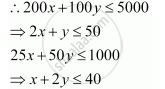
Total numbers of cakes, Z, that can be made are, Z = x + y
The mathematical formulation of the given problem is
Maximize Z = x + y … (1)
subject to the constraints,

The feasible region determined by the system of constraints is as follows.
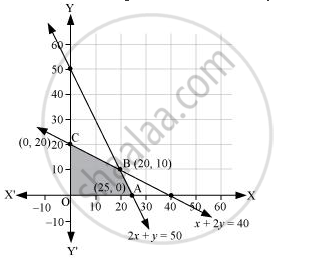
The corner points are A (25, 0), B (20, 10), O (0, 0), and C (0, 20).
The values of Z at these corner points are as follows.
| Corner poin | Z = x + y | |
| A(25, 0) | 25 | |
| B(20, 10) | 30 | → Maximum |
| C(0, 20) | 20 | |
| O(0, 0) | 0 |
Thus, the maximum numbers of cakes that can be made are 30 (20 of one kind and 10 of the other kind).
