Advertisements
Advertisements
Question
One chord of a circle is known to be 10 cm. The radius of this circle must be
Options
5 cm
greater than 5 cm
greater than or equal to 5 cm
less than 5 cm
Advertisements
Solution
greater than 5 cm
We are given length of a chord to be 10 cm and we have to give information about the radius of the circle.
Since in any circle, diameter of the circle is greater then any chord.
So diameter > 10
⇒ 2r > 10
⇒ r > 5 cm
APPEARS IN
RELATED QUESTIONS
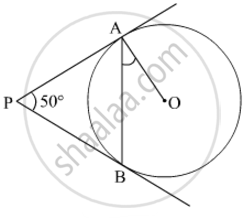
In figure, PA and PB are tangents to the circle with centre O such that ∠APB = 50°. Write the measure of ∠OAB.
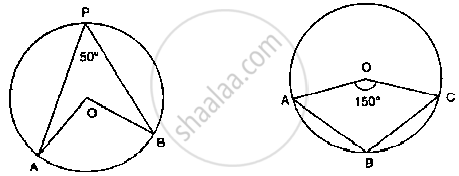
In the below fig. O is the centre of the circle. If ∠APB = 50°, find ∠AOB and ∠OAB.
If \[d_1 , d_2 ( d_2 > d_1 )\] be the diameters of two concentric circle s and c be the length of a chord of a circle which is tangent to the other circle , prove that\[{d_2}^2 = c^2 + {d_1}^2\].
Find the length of the chord of a circle in the following when:
Radius is 1. 7cm and the distance from the centre is 1.5 cm
Draw a circle of radius 3.6 cm. In the circle, draw a chord AB = 5 cm. Now shade the minor segment of the circle.
Draw a line AB = 8.4 cm. Now draw a circle with AB as diameter. Mark a point C on the circumference of the circle. Measure angle ACB.
A line segment which joins any two points on a circle is a ___________
If the radii of two concentric circles are 4 cm and 5 cm, then the length of each chord of one circle which is tangent to the other circle is ______.
If angle between two tangents drawn from a point P to a circle of radius a and centre O is 60°, then OP = `asqrt(3)`
The tangent to the circumcircle of an isosceles triangle ABC at A, in which AB = AC, is parallel to BC.
