Advertisements
Advertisements
Question
Obtain the condition for not toppling for a four-wheeler. On what factors does it depend, and in what way? Think about the normal reactions - where are those and how much are those!
Advertisements
Solution
There will be rollover (before skidding) if τt ≥ τr, that is if,
fs . h ≥ `mg*b/2`
i.e., if `f_s/mg ge b/(2 h)` or `a_r/g ge b/(2 h)`
or μs ≥ `b/(2 h)` ...(∵ fs = μsN = μsmg)
The vehicle parameter ratio, `b/(2 h)`, is called the static stability factor (SSF). Thus, the risk of a rollover is low if SSF ≤ μs. A vehicle will most likely skid out rather than roll if μs is too low, as on a wet or icy road.
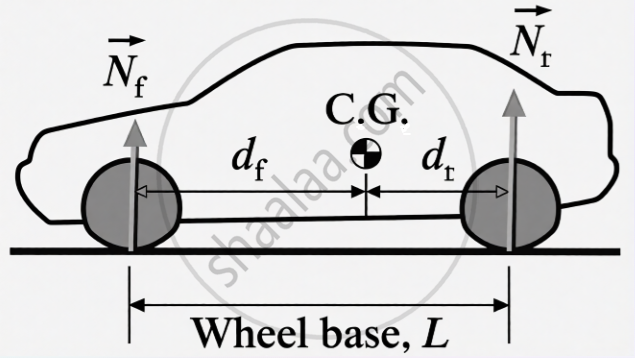
In a simplified vehicle model, we assume the normal reactions act equally on all four wheels, i.e., mg/4 on each wheel. However, the C.G. is not at the geometric centre of a vehicle, and the wheelbase (i.e., the distance L between its front and rear wheels) affects the weight distribution of the vehicle. When a vehicle is not accelerating, the normal reactions on each pair of front and rear wheels are, respectively,
Nf = `d_r/L mg` and Nt = `d_f/L mg`
where dr and df are the distances of the rear and front axles from the C.G.
