Advertisements
Advertisements
Question
Name the type of joint between the following:
Between phalanges
Advertisements
Solution
Hinge joint
APPEARS IN
RELATED QUESTIONS
Some people in old age complain of stiff joints. What do you think could be a possible reason for it?
Alongside is shown a diagrammatic skeletal of synovial j oint.
(a) What is a synovial joint?
(b) Where do you find such a joint?
(c) What is the function of cartilages?
(d) Name the parts 1 to 5. 2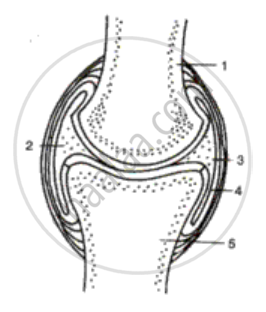
The ______ is seen in fingers and toes.
Hinge joint is slightly movable joint.
Answer the following:
What is a ball and socket joint?
______ is not found in arm bone.
An immovable joint is found in the ______.
How are joints classified? Explain with an example.
Unscramble the jumbled word and write it in the blank space provided.
iontcaronct ................
Which of the following joints do not allow any movement?
What is the type of movable joint present between the atlas and axis?
Knee joint and elbow joint are examples of ______.
How do our bone joints function without grinding noise and pain?
Give the location of a ball and socket joint in a human body.
Name the type of joint between the following:
Carpal/metacarpal of thumb
Match List I with List II.
| List I | List II |
| A. Fibrous joints | I. Adjacent vertebrae, limited movement |
| B. Cartilaginous joints | II. Humerus and Pectoral girdle, rotational movement |
| C. Hinge joints | III. Skull, don’t allow any movement |
| D. Ball and socket joints | IV. Knee, help in locomotion |
Choose the correct answer from the options given below:
Match List I with List II:
| List I (Type of Joint) | List II (Found between) |
| A. Cartilaginous Joint | I. Between flat skull bones |
| B. Ball and Socket Joint | II. Between adjacent vertebrae in vertebral column |
| C. Fibrous Joint | III. Between carpal and metacarpal of thumb |
| D. Saddle Joint | IV. Between Humerus and Pectoral girdle |
Choose the correct answer from the options given below:
