Advertisements
Advertisements
Question
Name the product formed and give the appropriate chemical equation for the following:
Sodium reacting with ethyl alcohol.
Advertisements
Solution
\[\ce{2C2H5OH + 2Na -> \underset{Sodium ethoxide}{2C2H5ONa} + \underset{Hydrogen}{H2 \uparrow}}\]
APPEARS IN
RELATED QUESTIONS
While studying saponification reaction, a student measures the temperature of the reaction mixture and also finds its nature using blue/red litmus paper. On the basis of his observations the correct conclusion would be
(A) the reaction is exothermic and the reaction mixture is acidic.
(B) the reaction is endothermic and the reaction mixture is acidic.
(C) the reaction is endothermic and the reaction mixture is basic.
(D) the reaction is exothermic and the reaction mixture is basic.
When you add a few drops of acetic acid to a test-tube containing sodium bicarbonate powder, which one of the following is your observation?
(A) No reaction takes place
(B) A colourless gas with pungent smell is released with brisk effervescence
(C) A brown coloured gas is released with brisk effervescence
(D) Formation of bubbles of a colourless and odourless gas
What type of compound is CH3COOH?
An organic compound X of molecular formula C2H4O2 gives brisk effervescence with sodium hydrogen carbonate. Give the name and formula of X.
Write the names of three compounds which can be oxidised directly or in stages to produce acetic acid.
Ester is a sweet-smelling compound.
Explain the following reaction with an example.
Saponification
Observe the figure and write the answers to the following questions.
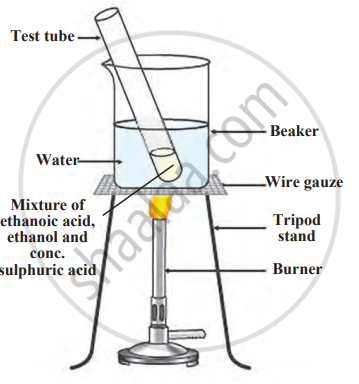
- Write the name of the reaction shown in the following figure.
- Write the above chemical reaction in the form of a balanced equation.
- Write the name of the product produced in the above reaction, write a use.
- Write the name of the catalyst used in the above reaction.
Which of these is not an organic acid?
Bubbles are seen in the test tube during the preparation of lime water.
