Advertisements
Advertisements
Question
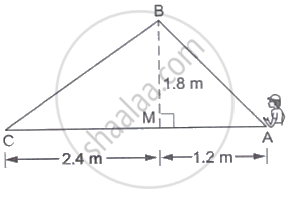
Naman is doing fly-fishing in a stream. The tip of his fishing rod is 1.8 m above the surface of the water and the fly at the end of the string rests on the water 3.6 m away from him and 2.4 m from the point directly under the tip of the rod. Assuming that the string (from the tip of his rod to the fly) is taut, how much string does he have out (see the adjoining figure)? If he pulls in the string at the rate of 5 cmcm per second, what will be the horizontal distance of the fly from him after 12 seconds?
Advertisements
Solution
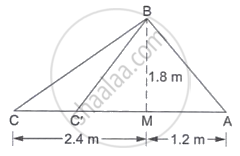
Length of the string that was out of the rod = BC
= `sqrt(BM^2 + CM^2)`
= `sqrt((1.8)^2 + (2.4)^2) m`
= `sqrt(3.24 + 5.76) m`
= `sqrt(9) m`
= 3 m
He pulls the string at a rate of 5 cm per second.
∴ Length of string pulled in 12 s
= (5 × 12) cm
= 60 cm
= 0.6 m
So, after 12 s, we have BC' = (3 – 0.6) m = 2.4 m and BM = 1.8 m.
∴ `C'M = sqrt((BC')^2 - BM^2)`
= `sqrt((2.4)^2 - (1.8)^2 m`
= `sqrt(2.52) m ≈ 1.5 m`
Horizontal distance of the fly from him after 12 s = C'A
= C'M + MA
= (1.6 + 1.2) m
= 2.8 m
