Advertisements
Advertisements
Question
Multiple Choice Question.
A hydraulic lift is designed to lift heavy objects of maximum mass 2000 kg. The area of cross-section of piston carrying the load is 2.25 × 10⁻² m2. What is the maximum pressure the smaller piston would have to bear?
Options
0.8711 × 10⁶ N/m2
0.5862 × 10⁷ N/m2
0.4869 × 10⁵ N/m2
0.3271 × 10⁴ N/m2
Advertisements
Solution
0.8711 × 10⁶ N/m2
Explanation:
Apply Newton’s second law of motion to find the force:
F = mg
Substitute the value mass as m = 2000 kg and acceleration due to gravity as g = 9.81 m/s2 to find the force exerted by the piston.
F = mg
F = 2000 kg × 9.81 m/s2
F = 19620 N
Use the law of pressure
p = `F/A`
Substitute the value of force as F = 19620 N, and area as A = 2.25 × 10⁻²m2 to calculate the maximum pressure the hydraulic lift can bear.
Pmax = `(19620N)/(2.25 xx 10^-2m^2)`
Pmax = 0.8711 × 10⁶Pa
APPEARS IN
RELATED QUESTIONS
Explain why The blood pressure in humans is greater at the feet than at the brain
Explain why Hydrostatic pressure is a scalar quantity even though the pressure is force divided by area.
A 50 kg girl wearing high heel shoes balances on a single heel. The heel is circular with a diameter 1.0 cm. What is the pressure exerted by the heel on the horizontal floor?
A man exerts same pressure on the ground whether he is standing or he is lying.
The unit of thrust is ..........
The unit of pressure is
Define the term ‘pressure’ and state its unit.
When does a man exert more pressure on the floor: while standing or while walking?
A normal force of 200 N acts on an area of 0.02 m2. Find the pressure in pascal.
The base of a container measures 15 cm × 20 cm. It is placed on a table top. If the weight of the container is 60 N, what is the pressure exerted by the container on the table top?
A boy weighing 60 kgf stands on platform of dimensions 2.5 cm x 0.5 cm. What pressure in pascal does he exert?
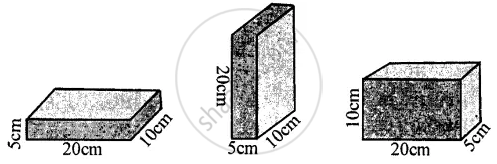
The figure shows a brick of weight 2 kgf and dimensions 20 cm × 10 cm × 5 cm placed in three different positions on the ground. Find the pressure exerted by the brick in each case.
An air bubble of radius 0.2 mm is situated just below the water surface. Calculate the gauge pressure. Surface tension of water = 7.2 × 10⁻² N/m.
In a pressure cooker, the food is cooked faster because ______.
An empty plastic bottle closed with an airtight stopper is pushed down into a bucket filled with water. As the bottle is pushed down, there is an increasing force on the bottom. This is because
A chapatti maker is a machine which converts balls of dough into chapatties. What effect of force comes into play in this process?
It is difficult to cut cloth using a pair of scissors with blunt blades. Explain.
Analogy
Broader straps: ______:: Thin needles: ______.
Explain why the cutting instruments are sharpened.
Give reasons why:
heavy trucks are fitted with 6 to 8 wheels
In petrol bunks, in what unit is tire pressure measured?
What is an Artisan aquifer?
Fluids in general are ______.
Scuba divers wear special suits to withstand ______.
The shape and size of the solids do not easily change.
What is the SI unit of pressure?
A vessel filled with water is kept on a weighing pan and the scale adjusted to zero. A block of mass M and density ρ is suspended by a massless spring of spring constant k. This block is submerged inside into the water in the vessel. What is the reading of the scale?
