Advertisements
Advertisements
Question
Moseley’s periodic table is based on atomic mass.
Options
True
False
Advertisements
Solution
False
Correct Statement: Moseley’s periodic table is based on atomic number.
APPEARS IN
RELATED QUESTIONS
State whether the following statement is true of false:
The elements in a group have consecutive atomic numbers.
A metal X is in the first group of the periodic table. What will be the formula of its oxide?
Give a reason why elements need to be properly classified.
The number of periods and groups in the periodic table are ______
______ group contains the member of the halogen family.
The elements of group 16 are called ______
Element ‘A’ has electronic configuration 2, 7; ‘B’ has electronic configuration 2, 8, 5 and ‘C’ has electronic configuration 2, 8, 7. Which two elements will exhibit similar chemical properties?
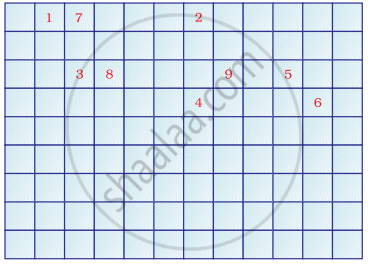
Complete the following cross word puzzle
Across:
(1) An element with atomic number 12.
(3) Metal used in making cans and member of Group 14.
(4) A lustrous non-metal which has 7 electrons in its outermost shell.
Down:
(2) Highly reactive and soft metal which imparts yellow colour when subjected to flame and is kept in kerosene.
(5) The first element of second Period
(6) An element which is used in making fluorescent bulbs and is second member of Group 18 in the Modern Periodic Table
(7) A radioactive element which is the last member of halogen family.
(8) Metal which is an important constituent of steel and forms rust when exposed to moist air.
(9) The first metalloid in Modern Periodic Table whose fibres are used in making bullet-proof vests
Relate the names of the following scientists with the statements given below.
Arranged elements into groups containing three elements each.
The atomic number of an element 'X' is 11.
- Write the electronic configuration of X and find its valency.
- Write the formula and nature of its oxide.
