Advertisements
Advertisements
Question
Mention, if the following statement is True or False
Deafness is caused due to the rupturing of the pinna.
Options
True
False
Advertisements
Solution
False
Correct Statement: Deafness is caused due to the rupturing of the eardrum.
APPEARS IN
RELATED QUESTIONS
Draw labelled diagrams of the following: Ear
Given below is a diagram depicting a defect of the human eye, study the same and then answer the questions that follow:
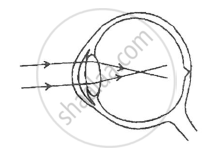
(i) Name the defect shown in the diagram.
(ii) What are the two possible that cause this defect?
(iii) Name the type of lens used to correct this defect.
(iv) With the help of a diagram show how the defect shown above is rectified using a suitable lens.
Differentiate between the Rods and Cones of Retina (Type of pigment)
Give technical terms for The nerve which transmits impulses from the ear to the brain
Complete the following sentence with appropriate word :
________ is the organ of balance and hearing in the body.
Select the CORRECT match of part of the human ear and its function.
The part of the ear that turns pressure variations into electrical signals is ______.
List the causes of noise pollution.
Define the following term:
Ear ossicles
Give reason:
Three small bones of ear ossicles are advantageous as compared to one single bone for hearing.
