Advertisements
Advertisements
Question
Match the type of unit cell given in Column I with the features given in Column II.
| Column I | Column II |
| (i) Primitive cubic unit cell | (a) Each of the three perpendicular edges compulsorily have the different edge length i.e; a ≠ b ≠ c. |
| (ii) Body centred cubic unit cell | (b) Number of atoms per unit cell is one. |
| (iii) Face centred cubic unit cell | (c) Each of the three perpendicular edges compulsorily have the same edge length i.e; a = b = c. |
| (iv) End centred orthorhombic cell | (d) In addition to the contribution from unit cell the corner atoms the number of atoms present in a unit cell is one. |
| (e) In addition to the contribution from the corner atoms the number of atoms present in a unit cell is three. |
Advertisements
Solution
| Column I | Column II |
| (i) Primitive cubic unit cell | (b) Number of atoms per unit cell is one. |
| (c) Each of the three perpendicular edges compulsorily have the same edge length i.e; a = b = c. | |
| (ii) Body-centred cubic unit cell | (c) Each of the three perpendicular edges compulsorily have the same edge length i.e; a = b = c. |
| (d) In addition to the contribution from unit cell the corner atoms the number of atoms present in a unit cell is one. | |
| (iii) Face centred cubic unit cell | (c) Each of the three perpendicular edges compulsorily have the same edge length i.e; a = b = c. |
| (e) In addition to the contribution from the corner atoms the number of atoms present in a unit cell is three. | |
| (iv) End-centred orthorhombic cell | (a) Each of the three perpendicular edges compulsorily have the different edge length i.e; a ≠ b ≠ c. |
| (d) In addition to the contribution from unit cell the corner atoms the number of atoms present in a unit cell is one. |
Explanation:
(i) 
For primitive unit cell, a = b = c
Total number of atoms per unit cell = `1/8 xx 8` = 1
Here, `1/8` is due to contribution of each atom present at comer.
(ii)
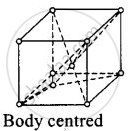
For body centered cubic unit cell, a = b = c.
This lattice contains atoms at comer as well as body centre.
Contribution due to atoms at comer = `1/8 xx 8` = 1
Contribution due to atoms at body centre = 8
(iii)
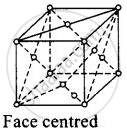
For face centred unit cell, a = b = c
Total constitutent ions per cell present at corners = `1/8 xx 8` = 1
Total constitutent ions per unit cell present at face centre = `1/2 xx 6` = 3
(iv)
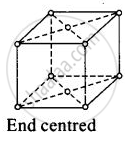
For end centred orthorhombic unit cell, a ≠ b ≠ c
Total contribution of atoms present at corner = `1/8 xx 8` = 1
Total constibution of atoms present at end centre = `1/2 xx 2` = 1
APPEARS IN
RELATED QUESTIONS
A unit cell of iron crystal has edge length 288 pm and density 7.86 g.cm-3. Find the number of atoms per unit cell and type of the crystal lattice.
Given : Molar mass of iron = 56 g.mol-1; Avogadro's number NA = 6.022 x 10²³.
An element crystallises in a b.c.c lattice with cell edge of 500 pm. The density of the element is 7.5g cm-3. How many atoms are present in 300 g of the element?
An element with molar mass 27 g mol−1 forms a cubic unit cell with edge length 4.05 ✕ 10−8 cm. If its density is 2.7 g cm−3, what is the nature of the cubic unit cell?
Distinguish between Face-centred and end-centred unit cells.
Explain with reason sign conventions of ΔS in the following reaction
N2(g) + 3H2(g) → 2NH3(g)
Calculate the number of unit cells in 8.1 g of aluminium if it crystallizes in a f.c.c. structure. (Atomic mass of Al = 27 g mol–1)
The density of silver having an atomic mass of 107.8 g mol- 1 is 10.8 g cm-3. If the edge length of cubic unit cell is 4.05 × 10- 8
cm, find the number of silver atoms in the unit cell.
( NA = 6.022 × 10²³, 1 Å = 10-8 cm)
The number of atoms per unit cell in a body centered cubic structure is ____________.
An atom located at the body center of a cubic unit cell is shared by ____________.
A metal has a body-centered cubic crystal structure. The density of the metal is 5.96 g/cm3. Find the volume of the unit cell if the atomic mass of metal is 50.
An element (atomic mass 100 g/mol) having bcc structure has unit cell edge 400 pm. The density of element is (No. of atoms in bcc, Z = 2).
Which of the following metal(s) show(s) hexagonal close-packed structure (hcp) and which show face-centered cubic (fcc) structure?
The edge length of fcc cell is 508 pm. If the radius of cation is 110 pm, the radius of anion is:
An element with atomic mass 100 has a bcc structure and edge length 400 pm. The density of element is:
Percentage of free space in body centred cubic unit cell is
If a represents the edge length of the cubic systems, i.e. simple cubic, body centred cubic and face centered cubic, then the ratio of the radii of the sphere in these system will be:-
In an ionic solid r(+) = 1.6 Å and r(−) = 1.864 Å. Use the radius ratio rule to the edge length of the cubic unit cell is ______ Å.
The ratio of number of atoms present in a simple cubic, body-centred cubic and face-centred cubic structure are, respectively ______.
