Advertisements
Advertisements
Question
Match the items in column-I to the items in column-II
| Column-I | Column-II | ||
| 1. | Linear expansion | (a) | change in volume |
| 2. | Superficial expansion | (b) | hot body to cold body |
| 3. | Cubical expansion | (c) | 1.381 X 10⁻²³ JK-1 |
| 4. | Cubical expansion | (d) | change in length |
| 5. | Boltzmann constant | (e) | change in area |
Advertisements
Solution
| Column-I | Column-II | ||
| 1. | Linear expansion | (d) | change in length |
| 2. | Superficial expansion | (e) | change in the area |
| 3. | Cubical expansion | (a) | change in volume |
| 4. | Cubical expansion | (b) | hot body to cold body |
| 5. | Boltzmann constant | (c) | 1.381 × 10⁻²³ JK-1 |
APPEARS IN
RELATED QUESTIONS
No medium is required for transfer of heat by the process of ______.
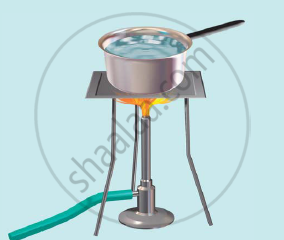
Look at Figure. Mark where the heat is being transferred by conduction, by convection and by radiation.
A wooden spoon is dipped in a cup of ice cream. Its other end ______.
Stainless steel pans are usually provided with copper bottoms. The reason for this could be that ______.
Select the correct alternative
If we add a lump of ice to a tumbler containing water,
Select the correct alternative
Heat in a liquid is transferred by
Maximum heat is absorbed by a ______ coloured object.
Why are the houses in Rajasthan painted white?
What are the modes of heat transfer?
Wrap a thin paper strip tightly around an iron rod. Try to burn the paper with candle while rotating the iron rod continuously. Does it burn? Explain your observation.
