Advertisements
Advertisements
Question
Match the terms of column A correctly with the phrases given in column B.
| A | B | ||
| 1 | Polyester | a | Prepared by using wood pulp |
| 2 | Teflon | b | Used for making parachutes and stockings |
| 3 | Rayon | c | Used to make non-stick cookware |
| 4 | Nylon | d | Fabrics do not wrinkle easily |
Advertisements
Solution
| A | B | ||
| 1 | Polyester | d | Fabrics do not wrinkle easily |
| 2 | Teflon | c | Used to make non-stick cookware |
| 3 | Rayon | a | Prepared by using wood pulp |
| 4 | Nylon | b | Used for making parachutes and stockings |
RELATED QUESTIONS
Mark (✓) the correct answer:
Rayon is different from synthetic fibres because
Fill in the blanks with appropriate words.
Synthetic fibres are also called ______ or _______ fibres.
Give examples which indicate that nylon fibres are very strong.
Synthetic fibre is also called _______ fibre.
Beans and peas are pulses.
True or False
It is good to wear clothes made of synthetic fibres while cooking.
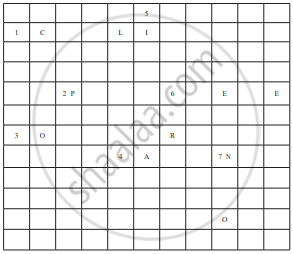
Crossword
Across
1. Fibre that is used as synthetic wool.
2. A plastic used for making water bottles.
3. A long chain made of small repeatingmonomers.
4. Another name for this semi-synthetic fibre is artificial silk.
Down
5. A type of fibre that is naturally obtained from a cocoon.
6. A synthetic fibre classified as polyester.
7. A polymer used for making rope.
The artificial fibers are also known as ______.
Complete the Analogy:
______: Films:: Nylon: Fishing nets.
A synthetic fiber which looks like silk is obtained by chemical treatment of wood pulp. It is, therefore, known as artificial silk. What is its common name?
