Advertisements
Advertisements
Question
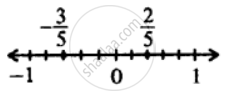
Mark the following pairs of rational numbers on the separate number lines: `2/5` and `(- 3)/5`
Sum
Advertisements
Solution
`2/5` and `(- 3)/5`
shaalaa.com
Is there an error in this question or solution?
APPEARS IN
RELATED QUESTIONS
Add the following rational numbers.
\[\frac{- 8}{11} and \frac{- 4}{11}\]
Re-arrange suitably and find the sum in each of the following:
\[\frac{4}{13} + \frac{- 5}{8} + \frac{- 8}{13} + \frac{9}{13}\]
Evaluate each of the following:
\[\frac{- 5}{14} - \frac{- 2}{7}\]
Fill in the blanks:
The product of two positive rational numbers is always .....
Fill in the blanks:
The product of a rational number and its reciprocal is .....
Find two rational numbers between\[\frac{1}{5} \text{and} \frac{1}{2} .\]
Arrange the following rational numbers in descending order.
`(4)/(3), (-14)/(5) and (17)/(15)`
The rational numbers `(-8)/3` and `8/3` are equidistant from __________
Which of the following is not true?
Every whole number is an integer.
