Advertisements
Advertisements
Question
Make a list of Indian Nobel Laureates.
- ____________
- ____________
- ____________
Advertisements
Solution
| No. | Name | Year | in |
| a. | Rabindranath Tagore | 1913 | Literature |
| b. |
Sir Chandrasekhara Venkata Raman |
1930 | Physics |
| c. | Mother Teresa | 1979 | Peace |
| d. | Amartya Sen | 1998 | Economic studies |
| e. | Kailash Satyarthi | 2014 | Peace |
APPEARS IN
RELATED QUESTIONS
Observe the pictures and answer.
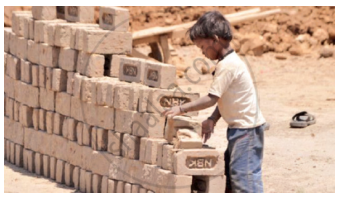 |
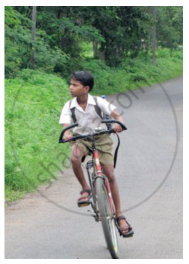 |
- Main difference between the two images
- Change required
- Your contribution as a student to help and make a difference to needy children.
Put a right or wrong
A good speech delivered requires the following characteristic.
Well planned and thoughts well-organized.
Put a right or wrong
A good speech delivered requires the following characteristic.
Speaker need not greet the dignitaries and audience.
Put a right or wrong
A good speech delivered requires the following characteristic.
Language used should be suitable to the audience.
Put a right or wrong
A good speech delivered requires the following characteristic.
Speaker should be passive, and have no facial expressions.
Put a right or wrong
A good speech delivered requires the following characteristic.
Speech should be supported by good examples/episodes/visual aids. (where possible)
Put a right or wrong
A good speech delivered requires the following characteristic.
Speaker should switch over from one language to another.
Read the expressions and insert them in the proper columns. Put the proper expression numbers in the right column.
| Greeting/Salutation | Introduction | Body of the Speech | Conclusion | Thanking the Audience |
Expressions:
- Imagine! After ten years, what will happen?
- Let me begin, today, by sharing my own experience.
- Honourable Chief Guest ....., eminent dignitaries, ladies and gentlemen.
- I don’t understand why we accept this issue so passively.
- I am Adarsh Birajdar, (designation) standing before you .....
- A renowned personality (name) says “.....”
- Good morning, to one and all present today.
- I express my deep gratitude to the organisers of this event/function .....
- Let me give you an example .....
- Thank you all for a patient listening and your interest in my talk.
- You must have noticed that .....
- Before I conclude, I would like you to think over the fact that .....
With the help of your teacher and classmates make a list of as many Indian Nobel Laureates as you can. (You can use Internet or school library.)
| Name | Nobel Prize for |
| ............ | ............ |
Name the following.
The greatest personalities from the land of Buddha
Name the following.
The foreign activists of equal rights, mentioned in the speech
Name the following.
So called daughters of Kailash Satyarthi.
Mention the social issues highlighted by Kailash Satyarthi in his speech. One social issue is given for you.
- Child labour
Think and give your own response.
What message does the little bird’s story of the forest fire convey to us? Explain.
Think and give your own response.
Name any other social activist who has worked/is working earnestly for child-welfare. Write about his/her activities.
What will you do in the following situation?
If you see a child working in a restaurant
What will you do in the following situation?
If you find a child working at a brickwork site.
What will you do in the following situation?
If you come across a beggar child.
Write any 2 efforts that you can make to enrol deprived children/out of school children into a school. One is given for you.
- I will persuade parents of such children to send them to school.
 |
 |
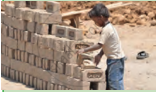
Discuss in your group.
- What difference do you notice in the two images?
- Which of the two situations, should change?
- How and when can the situation change?
- How can you, as a student, contribute and help make a difference to the needy children?
What does a good well-organized speech contain?
Read the expressions given below and insert them in your notebook in the proper boxes, as shown below:
- Imagine what will happen after ten years.
- I would like to share with you an example from my own experience.
- Hon. chief guest, eminent dignitaries, respected management and staff, student-friends
- The research report says that ______
- I don’t understand why we are so negative about this issue.
- Think again and again and then move forward.
- Today, I would like to put forth my views on ______
- The renowned personality xyz says “______”
- Good Morning, one and all present today.
- I would like to express my gratitude towards the organisers of this function for giving me opportunity ______
- If we think about the situation around us, we notice that ______
- Let me explain this to you ______
| Greeting/ Salutation | Introduction | Body of the speech | Conclusion |
The greatest personalities from the land of Buddha -
The ‘Daughters’ of Kailash Satyarthi mentioned in his speech -
The foreign activists of equal rights, mentioned in the speech -
Mention the social issues highlighted by Kailash Satyarthi in his speech. One social issue is given for you.
- Child labour
- ____________
- ____________
- ____________
- ____________
Complete the following diagram/chart.
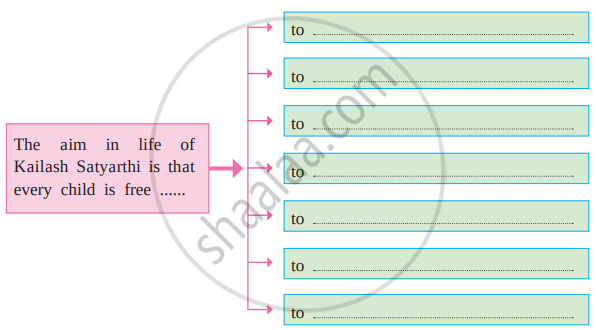
Complete the following web chart.

Write any 2 efforts that you can make to enroll deprived children/out of school children into a school. One is given for you.
- I will persuade parents of such children to send them to school.
- __________________
- __________________
- __________________
- __________________
Today, it is time for every child to have a right to -
education, _______, _______, _______, _______, _______, _______, _______, _______.
Read the following passage and do the activities:
B1. Who said to whom? (2)
| Sentence | Who said | To whom | |
| i. | Is the world so poor that it cannot give me a toy and a book? | ||
| ii. | What is my fault? |
|
Twenty years ago, in the foothills of the Himalayas, I met a small, skinny child labourer. He asked me : “Is the world so poor that it cannot give me a toy and a book instead of forcing me to take a gun or a tool?” I met with a Sudanese child soldier. He was kidnapped by an extremist militia. As his first training lesson, he was forced to kill his friends and family. He asked me: “What is my fault?” Friends, all the great religions teach us to care for our children. Jesus said: “Let the children come to me; do not hinder them, for the kingdom of God belongs to them.” The Holy Quran says: “Kill not your children because of poverty.” Friends! There is no greater violence than to deny the dreams of our children. Therefore ... I refuse to accept that all the temples and mosques and churches and prayer houses have no place for the dreams of our children. I refuse to accept that the world is so poor, when just one week of global military expenditure can bring all the children to classrooms. |
B2. Complete the web: (2)
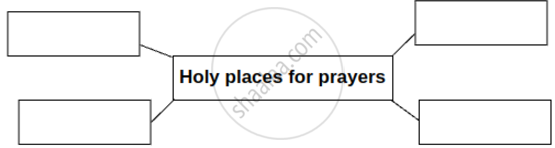
B3. Write the describing words for the following from the passage: (2)
| i. | ____________ | Week |
| ii. | ____________ | Quaran |
| iii. | ____________ | Violence |
| iv. | ____________ | religions |
B4. Do as Directed: (2)
- He asked me, “What is my fault?” (Choose the correct indirect speech from the following)
- He asked me what is his fault.
- He asked me what was his fault.
- He asked me what his fault is.
- He asked me what his fault was.
- He was forced to kill his friends and family.
(Rewrite the sentence and underline the infinitive)
B5. Personal Response: (2)
What will you do if you find a poor and needy child? Explain.
