Advertisements
Advertisements
Question
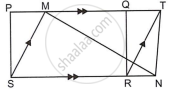
M is a point on side PQ of rectangle PQRS. SR is produced to a point N and MSRT is a parallelogram. PQ = 8.5 cm, PS = 6 cm. Find the area of
- parallelogram MSRT
- ΔMNT
Advertisements
Solution
Given:
- PQ = 8.5 cm
- PS = 6 cm
- MSRT is a parallelogram
- M is a point on side PQ
- SR is produced to a point N
- We need to find the area of parallelogram MSRT and triangle MNT.
Step-by-step approach:
1. Understanding the problem:
The parallelogram MSRT is formed such that MS || RT and SR || MT.
The point N lies on the extension of line SR.
The area of the parallelogram MSRT can be calculated using the formula for the area of a parallelogram:
Area of parallelogram = Base × Height
The base will be the length of side SR and the height will be the perpendicular distance between lines SR and MT.
2. Finding the area of parallelogram MSRT:
The area of parallelogram MSRT is given by:
Area of MSRT = PQ × PS
Substituting the given values:
Area of MSRT = 8.5 × 6
= 51 cm2
3. Finding the area of triangle MNT:
Since triangle MNT is half of parallelogram MSRT (because the area of a triangle formed by one of the diagonals of a parallelogram is half of the parallelogram’s area), we can calculate its area as:
Area of triangle = `1/2` × Area of parallelogram
Substituting the area of parallelogram MSRT:
Area of triangle MNT = `1/2` × 51
= 25.5 cm2
