Advertisements
Advertisements
Question
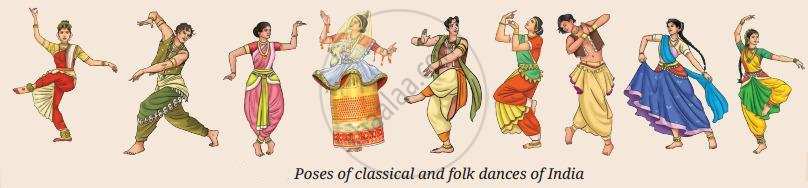
Look at the picture given below (Fig.). Carefully observe the various poses of classical and folk dances of India. Can you identify which joints are involved? Also, what type of movement each joint allows?
Very Long Answer
Advertisements
Solution
In Indian classical and folk dances, different bodily joints are used to create varied movements:
- Neck joint (pivot joint): Allows for side-to-side movement while assisting the body in smooth and controlled rotation around a single axis.
- Shoulder joint (ball and socket joint): allows movement in all directions (circular movement), which helps in beautiful arm movements.
- Elbow joint (hinge joint): Allows for back-and-forth movement, which is utilised to bend and straighten the arms.
- Wrist joint (gliding joint): Allows for minor motions in various directions, which is useful for hand gestures (mudras).
- Hip joint (ball and socket joint): It allows movement in all directions, which helps in body bending and leg movements.
- Knee joint (hinge joint): Allows the legs to bend and straighten, which is necessary for steps and jumps.
- Ankle joint (gliding joint): Promotes foot motion and balance.
shaalaa.com
Is there an error in this question or solution?
