Advertisements
Advertisements
Question
Look at the newspaper clipping given below and answer the questions that follow:
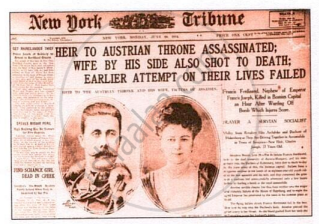
- What was the immediate impact of the incident mentioned in newspaper clipping? Who organised the assassination? What was the objective behind the assassination?
- Besides the incident mentioned in the newspaper, state three other reasons that led to a turning point in the history of the world.
- Name the treaty that was designed to prevent Germany from going to war again. State any three clauses of this treaty.
Very Long Answer
Advertisements
Solution
-
- Immediate impact: Austria‑Hungary treated the Sarajevo assassination as an attack backed by Serbia and, after issuing an ultimatum Serbia could not fully accept, Austria‑Hungary declared war on Serbia (Austria declared war on Serbia on 28 July 1914).
- Who organised the assassination: the killing was carried out by Serbian nationalists organised by a secret society known as the “Black Hand” (also called the Union of Death).
- Objective behind the assassination: Serbian nationalists wanted to unite Serb‑populated territories and create a Greater Serbian (or single Serbian) state, and the attack aimed to further that nationalist cause.
-
- Aggressive nationalism and intense economic/industrial rivalry among the great powers, which created mutual suspicion and readiness to use force.
- The arms race/militarism, major powers massively expanded armies and navies and prepared war plans, increasing the likelihood that a crisis would escalate into general war.
- Imperial and colonial rivalries (competition for colonies, trade and sea‑routes) that produced international tension and rival blocs.
-
- Name of the treaty: The Treaty of Versailles (1919).
- Three clauses (examples):
- War‑guilt and responsibility, the treaty declared Germany responsible for the war (the “war‑guilt” basis for reparations).
- Demilitarisation of the Rhineland and Allied occupation, the Rhine valley was to be demilitarised and the territory west of the Rhine occupied by Allied troops for a set period (15 years).
- Military restrictions and territorial losses, Germany’s armed forces were severely limited (e.g., army size and naval restrictions; air force and submarines banned), and Germany lost colonies and certain European territories (for example the Saar coal area was put under international/temporary control and ceded uses to France).
shaalaa.com
Is there an error in this question or solution?
