Advertisements
Advertisements
Question
Long Answer Question:
Justify the statement. If the answer is false, change the underlined word(s) to make the statement true
The DNA molecule is double-stranded and the RNA molecule is single-stranded.
Options
True
False
Advertisements
Solution
True.
- The DNA is responsible for storing genetic information and also preserving it for the next generation of cells. Thus, it needs to be stable and resistant to enzymatic or oxidative alteration.
- The double-stranded DNA molecule is so designed that the part which stores the genetic information; the nitrogenous base pairs are stacked inward.
- Phosphate groups `("PO"_4^(-))` keep the base pairs safe inside form the backbone. DNA is further wrapped up around histone proteins into chromosomes which keep it condensed. This would not be possible if it were only single-stranded.
- RNA is not meant to last long and acts as a template carrying information which is copied from the DNA. Using protein-synthesizing machinery, it forms a protein. After which is disintegrates and digested.
APPEARS IN
RELATED QUESTIONS
Enlist the characteristics of genetic code.
Describe the process of transcription in protein synthesis.
Long Answer Question:
Describe the process of translation in protein synthesis.
In which of the following synthesis of DNA strand is not involved directly?
Define.
Translation
Identify the strand of DNA which acts as a template during transcription.
____________ refers to the mechanism in which codons of mRNA are translated and specific amino acids in a sequence form a polypeptide on ribosomes.
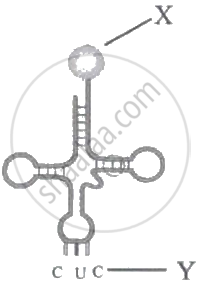
What does 'X' and 'Y' represent in the following diagram oft-RNA molecule?
During protein synthesis, a ribosome moves from 5 to 3 and of mRNA to recognize all codons. This movement of ribosome is called:
Draw flow chart of Central Dogma.
