Advertisements
Advertisements
Question
Is the uniform circular motion accelerated? Give reasons for your answer.
Advertisements
Solution
When an object is moving with a constant speed along a circular path, the velocity changes due to the change in direction. Hence it is an accelerated motion.
APPEARS IN
RELATED QUESTIONS
A vehicle is moving on a circular track whose surface is inclined towards the horizon at an angle of 10°. The maximum velocity with which it can move safely is 36 km / hr. Calculate the length of the circular track. [π = 3.142]
Explain the meaning of uniform circular motion. Give one example of such motion.
A string of length `l` is fixed at one end and carries a mass 'm' at the other end. The mass is revolving along a horizontal circle of radius 'r' making 'θ' as the semi-vertical angle of cone and `(1/pi)` revolutions per second around the vertical axis through fixed end. The tension in the string is ______.
A point object moves along an arc of a circle of radius 'R'. Its velocity depends upon the distance covered 'S' as V = `Ksqrt(S)` where 'K' is a constant. If 'e' is the angle between the total acceleration and tangential acceleration, then
A particle is given an initial speed u inside a smooth spherical shell of radius R = 1 m that it is just able to complete the circle. Acceleration of the particle when its velocity is vertical is ______.

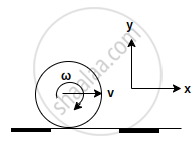
A disc of radius 5 cm rolls on a horizontal surface with linear velocity v = 1`hat"i"` m/s and angular velocity 50 rad/s. Height of particle from ground on rim of disc which has velocity in vertical direction is ______ cm.
A particle is performing a uniform circular motion along a circle of radius R. In half the period of revolution, its displacement and distance covered are respectively.
A wheel is rotating at 900 rpm about its axis. When the power is cut off it comes to rest in 1 min. The angular retardation (assumed to be uniform (in rad s-1) is ______.
A thin uniform circular disc of mass M and radius R is rotating in a horizontal plane about an axis passing through its centre and perpendicular to its plane with an angular velocity ω. Another disc of same dimensions, but of mass `1/4`M is placed gently on the first disc co-axially. The. angular velocity of the system is ______.
By applying Kepler's third law to the formula for centripetal force, Newton concluded that the force acting on a planet is:
